
Copy Fail Changes the Security Conversation

Copy Fail Changes the Security Conversation
Why Infrastructure Accountability Matters More Than Ever


On April 29, 2026, security researchers disclosed one of the most alarming Linux privilege escalation vulnerabilities in years: “Copy Fail” (CVE-2026-31431).


At first glance, it may have looked like just another Linux kernel vulnerability announcement. But Copy Fail represents something far more serious. The exploit was reliable, quiet, easy to execute, and effective across nearly every major Linux distribution released since 2017. Even more concerning, researchers indicated that AI-assisted analysis helped accelerate discovery and exploitation research, highlighting a rapidly changing cybersecurity landscape where dangerous vulnerabilities can move from discovery to weaponization faster than most organizations can operationally respond.


For businesses running SaaS platforms, Kubernetes clusters, CI/CD pipelines, virtualized infrastructure, or cloud-hosted Linux workloads, Copy Fail is a reminder that infrastructure can no longer be treated as a commodity. Modern environments require intentional engineering, continuous oversight, and operational accountability.


This is where Application-Aware Infrastructure (AAI) changes the conversation.


What Is Copy Fail?


Copy Fail is a critical Linux kernel local privilege escalation vulnerability affecting the kernel’s cryptographic subsystem, specifically the algif_aead and authencesn components. The flaw traces back to a kernel optimization introduced in 2017. The optimization unintentionally enabled writable page cache manipulation within the Linux kernel. The result? An unprivileged user could gain root-level access using a relatively small and simple Python script.


What made the vulnerability especially alarming was not just the ability to escalate privileges, but how quietly it could happen. Attackers could modify privileged binaries in memory without altering the actual file stored on disk. That distinction is important because many traditional security tools still rely heavily on file-based monitoring, hash validation, and integrity checking. If the file itself never changes, many organizations may have little visibility into the attack taking place.


Researchers also demonstrated the potential for container escapes in shared Kubernetes environments, compromise of CI/CD systems, and attacks against cloud-hosted Linux workloads. The exploit proved highly portable across environments, making it operationally dangerous for organizations running modern Linux infrastructure at scale.


Copy Fail manipulated behavior in memory, making detection significantly harder for organizations relying solely on traditional endpoint security approaches.


Why Copy Fail Is Different


Many severe vulnerabilities require a complicated series of steps to successfully exploit. Attackers often need precise timing, highly customized environments, or multiple chained weaknesses to gain meaningful access. Copy Fail dramatically lowered that barrier.


Researchers described it as extremely reliable, consistent across distributions, easy to weaponize, and highly stealthy. That level of consistency fundamentally changes risk exposure because it allows attackers to move faster and more confidently. A vulnerability that works consistently across environments becomes much easier to operationalize in real-world attacks.


This is part of a larger shift occurring across cybersecurity. Threat actors no longer need the same level of sophistication that was once required to exploit advanced infrastructure weaknesses. As offensive research becomes more automated and AI-assisted tooling becomes more accessible, the timeline between vulnerability discovery and active exploitation continues to shrink.

AI Is Accelerating the Cybersecurity Arms Race


While the technical details of Copy Fail are important, the larger story may be even more significant. Researchers reportedly used AI-assisted analysis to help surface the vulnerability rapidly. AI is now accelerating vulnerability discovery, exploit development, reverse engineering, malware modification, and attack automation at a pace the industry has never experienced before.


Historically, discovering deep kernel vulnerabilities required highly specialized expertise and significant research time. Today, AI-assisted workflows can dramatically compress portions of that process. Attackers and researchers alike can analyze code faster, identify weak patterns more efficiently, and automate portions of offensive security research that previously demanded extensive manual effort.


For organizations, this means the operational window for response is shrinking. Vulnerabilities may move from disclosure to active exploitation in hours instead of weeks. Security can no longer rely on slow patch cycles, fragmented ownership, or reactive operational models.


The Real Problem Is Operational Security


Most organizations still approach cybersecurity primarily through tooling. When new threats emerge, the instinct is often to purchase another endpoint product, add another SIEM, deploy another EDR agent, or implement another layer of monitoring software. However, modern threats increasingly exploit operational weaknesses rather than missing tools:

  • Misconfigured infrastructure
  • Shared environments
  • Weak segmentation
  • Poor visibility
  • Excessive permissions


In many organizations, infrastructure responsibility is fragmented across multiple vendors, internal teams, and cloud providers. When a major vulnerability emerges, nobody has complete operational accountability.


That creates dangerous delays.


Teams suddenly begin asking who owns remediation, who validates exposure, who coordinates updates, and who is responsible for verifying the environment is secure afterward. In fast-moving security incidents, that confusion becomes a vulnerability in itself.


Infrastructure accountability is rapidly becoming one of the most important components of modern cybersecurity.


Why Infrastructure Accountability Matters


Security tools are important, but accountability is what determines how effectively organizations respond under pressure. Modern infrastructure environments are too complex for passive management models. Organizations need operational ownership from teams that deeply understand the applications, workloads, dependencies, and infrastructure layers involved.


That ownership includes continuous monitoring, lifecycle management, proactive vulnerability response, segmentation oversight, and operational governance. Without it, even well-funded environments can struggle during critical incidents.


As threats accelerate, operational maturity becomes just as important as technical capability.

How Protected Harbor Helps Mitigate Threats Like Copy Fail


Protected Harbor’s Application-Aware Infrastructure model was designed specifically to address the operational gaps that modern threats increasingly exploit. Rather than treating infrastructure as generic compute resources, Protected Harbor engineers environments around the actual behavior and requirements of the applications they support. That deeper operational understanding becomes critical when responding to vulnerabilities like Copy Fail.


1. Rapid Patch Management & Operational Ownership


When major vulnerabilities emerge, response time matters. Many organizations struggle because internal teams are already stretched thin or because infrastructure ownership is fragmented across providers and departments. Protected Harbor helps streamline response through active infrastructure monitoring, managed operating systems, coordinated patch management, kernel oversight, and lifecycle governance.


2. Zero Trust Architecture Reduces Blast Radius


Copy Fail is dangerous because it allows privilege escalation immediately after initial access is achieved. Protected Harbor’s Zero Trust approach helps reduce risk through:

  • Segmented environments
  • Identity-based access controls
  • Least privilege enforcement
  • Network isolation
  • Dedicated tenant architectures
  • Continuous authentication policies


Even if an attacker gains foothold access, properly engineered segmentation can significantly limit lateral movement and contain exposure.


3. Application-Aware Infrastructure Detects Abnormal Behavior Faster


Protected Harbor emphasizes visibility beyond traditional infrastructure metrics. Modern attacks often reveal themselves operationally before they trigger conventional security alerts. By understanding expected workloads, user behavior, service dependencies, authentication patterns, and application baselines, Application-Aware Infrastructure can help organizations identify abnormal activity earlier and respond faster.


4. Dedicated Environments Reduce Shared Infrastructure Exposure


Dedicated infrastructure further reduces shared-environment risk. In heavily shared environments, vulnerabilities affecting kernels or containerization layers can create broader exposure concerns. Protected Harbor’s private cloud and dedicated infrastructure offerings help organizations reduce these risks through isolated workloads, dedicated Active Directory environments, controlled infrastructure layers, and custom security policies tailored to the application itself.


5. Continuous Security Oversight


Protected Harbor’s managed security and vCISO services help organizations maintain:

  • Ongoing vulnerability management
  • External scanning
  • Security benchmarking
  • Risk assessments
  • Patch governance
  • Incident preparedness
  • Compliance alignment

Security cannot be a one-time initiative; it requires continuous operational discipline.


AI Is Accelerating Both Innovation & Risk


Copy Fail is more than a Linux vulnerability story. It is a warning about where cybersecurity is headed. AI is accelerating innovation, infrastructure scale, vulnerability discovery, and attacker capability all at once. Organizations can no longer rely solely on reactive security models or generic infrastructure strategies.


The environments that remain resilient moving forward will be the ones built around operational accountability, continuous monitoring, application awareness, and security-first engineering principles.


At Protected Harbor, we believe infrastructure should do more than simply exist. It should be intentionally engineered around the applications it supports, continuously monitored for abnormal behavior, strategically secured against evolving threats, and operationally owned by a single partner accountable for outcomes.


Because when the next critical vulnerability emerges — and it will — the organizations that respond fastest and operate most intelligently will be the ones that stay secure and operational.


Contact our team for a complimentary Infrastructure Risk Assessment where we will evaluate your environment and identify:

  • Areas of vulnerability
  • Cyberattack blast radius
  • Performance bottlenecks tied to infrastructure design


No obligation — just clarity on where you stand.
Ransomware Risk Is Designed

Ransomware Risk is Designed

Ransomware Risk Isn’t Random — It’s Designed by Your Environment


Most cyberattacks don’t need to rely on advanced exploits. Many successful incidents rely on exploiting predictable, preventable internal weaknesses. Attackers don’t need to outsmart your defenses — they can just look for:

  • Weak or missing authentication controls
  • Excessive access once inside
  • The ability to destroy recovery options


These are not edge cases — they’re common operational gaps. Ransomware success isn’t about how advanced the attacker is — it’s about how exposed your environment is. Ransomware doesn’t succeed because an attacker got lucky. It succeeds because the environment allowed it to succeed. Ransomware follows the path you’ve already built. Attackers don’t need to create complexity when they can just exploit what’s already there.


In our previous blogs, we looked at how mixed-use servers and flat networks increase your vulnerability to ransomware. In this blog, we are going to focus on common identity/ access weaknesses, and why protecting your backups is one of the most crucial ways to save your business.


The Keys to the Kingdom


Organizations must properly manage user accounts and be mindful of excessive permissions. If one account can access everything, one compromise can destroy everything. Mismanaged accounts and permissions can look like:

  • Users with access far beyond their job function
  • Service accounts with domain-level privileges
  • Shared admin credentials across teams
  • Wide-open file shares
  • Dormant accounts still active


Many environments evolve over time without governance, which can lead to permission creep, forgotten accounts, and inconsistent access policies. These issues also occur when an organization is coordinating multiple vendors and there is no clear ownership. Once an attacker gains any valid credentials, they can blend in as a legitimate user, avoid detection by security tools, and move faster than traditional defenses can react.


If an attacker obtains access to an ‘overprivileged’ account, you’re essentially giving them the keys to the kingdom. This broad access means attackers don’t need to hack your systems to wreak havoc — all they need to do is log in.

Once in, attackers will:

  • Use stolen credentials to access multiple systems
  • Escalate privileges using misconfigurations
  • Move laterally without triggering alarms
  • Quickly access sensitive data and critical systems


Authentication = trust. If identity controls are weak, attackers can inherit that trust.


Hidden Risks & How to Prevent Them


Hidden risks include:

  • Dormant accounts: Old employees, contractors, test accounts.
  • Shadow IT: Accounts created outside of IT oversight.
  • Lack of access reviews: Permissions are never reevaluated.
  • Flat directory structures: No separation of privilege tiers.
  • Wide-open share permissions: “Everyone” or “Domain Users” can access critical shares.


All of these risk factors create an easy staging ground for ransomware encryption.


What to do instead:

  • Enforce least privilege (only what’s needed, nothing more)
  • Conduct regular access reviews
  • Automate processes for employees who join, move, or leave
  • Segment administrative roles
  • Lock down shared resources with clear ownership


Ransomware Doesn’t Need to Break In — It Logs In & Spreads


Let’s see an example. An organization tends to be lax with their permissions, but their security is otherwise strong. A user unknowingly clicks on a malicious link, introducing malware into the environment. Once inside the environment, the attackers focus on getting access to local admin so they can extend that access to the entire deployment. This is known as escalation of privilege. If the organization does not utilize deep monitoring, they might not be alerted to suspicious activity in their environment. By the time they realize, it may already be too late. Once an organization is locked out of their deployment, an attacker may deploy ransomware or scan the deployment for sensitive information (e.g., social security numbers, payment information, files that contain keywords like ‘password’ in the name).


Attackers always target data because data is currency. Once your data is within their grasp, they can steal it, sell it, hold it for ransom — your entire organization will be jeopardized.

The Open Door Problem


Passwords alone are not enough. This is because passwords are often reused across systems, easily phished, and frequently exposed in breaches. Attackers heavily rely on phishing campaigns, credential stuffing, and password spraying because these methods require minimal effort with a high success rate.


Multi-factor authentication (MFA) introduces a second factor, creating a barrier than can block most automated attacks. Even if credentials are compromised, attackers can’t log in without the second factor (for example, validating a log-in attempt with an authenticator app). Without MFA, stolen credentials are often all attackers need: you’re leaving the door open for hackers to walk right in.


MFA isn’t a silver bullet, but it can stop the vast majority of opportunistic attacks. Using MFA isn’t about being unbreakable, it’s about:

  • Increasing effort for attackers
  • Reducing attack success rates
  • Creating additional detection opportunities


Roll out MFA for email systems, remote access (VPNs), and administrative accounts. App-based authenticators should be used over SMS when possible. Risk-based/ adaptive MFA takes this a step further by evaluating the circumstances around a login attempt (device posture, location, IP reputation, login behavior, etc.) before granting access. It’s also key to educate your users so that they know to never approve unexpected prompts.


The Final Line of Defense


The harsh reality is that modern ransomware doesn’t just encrypt data, it targets backups first, disables recovery mechanisms, and exfiltrates data for double extortion. Common backup mistakes include:

  • Backups connected to the same domain
  • Always-online backup systems
  • Shared credentials between production and backup environments
  • No immutability


Backups are your last line of defense — these mistakes make backups discoverable, accessible, and destroyable.


When backups fail, downtime increases dramatically, ransomware pressure rises, and recovery becomes slow, partial, or impossible. A strong backup strategy looks like:

  • Immutable backups: Cannot be altered or deleted.
  • Offline/ air-gapped copies: Not accessible from the production network.
  • Separate credentials/ domains: Limits an attacker’s access.
  • Multiple backup tiers: Onsite + offsite.
  • Testing: Many organizations perform backups regularly, but never test restores.


Testing is one of the most skipped, and arguably most critical, steps. Testing is key for verifying data integrity, ensuring systems can actually be rebuilt, identifying gaps in the recovery process, and reducing panic during real incidents. A backup that hasn’t been tested is an assumption — not a solution.


From One Login to Total Shutdown


The critical business reality is that organizations who cannot recover quickly lose significant revenue, lose customer trust, and if the attack is bad enough, have to shut down entirely. This is why a multi-layered approach is crucial for protecting yourself against cyber threats. You want to ensure that if one layer of protection goes down, the others will be there to hold the line of defense. If not, you’re completely exposed. Organizations must understand that implementing layers of defense doesn’t happen randomly, it has to be designed.


Flat networks, mixed-use servers, mismanaged permissions, missing MFA, backup mistakes — these failures don’t happen by accident. Implementing layers of protection takes conscious thought, planning, and effort.  That is why it is so important to have infrastructure that is application-aware and built with security top of mind. Individually, each of these failures are risky. Combined, they create a near-guaranteed path to full business disruption.

No single failure causes the breach, but the damage can be catastrophic when you lack:

  • Layered defenses
  • Containment
  • Recovery capabilities


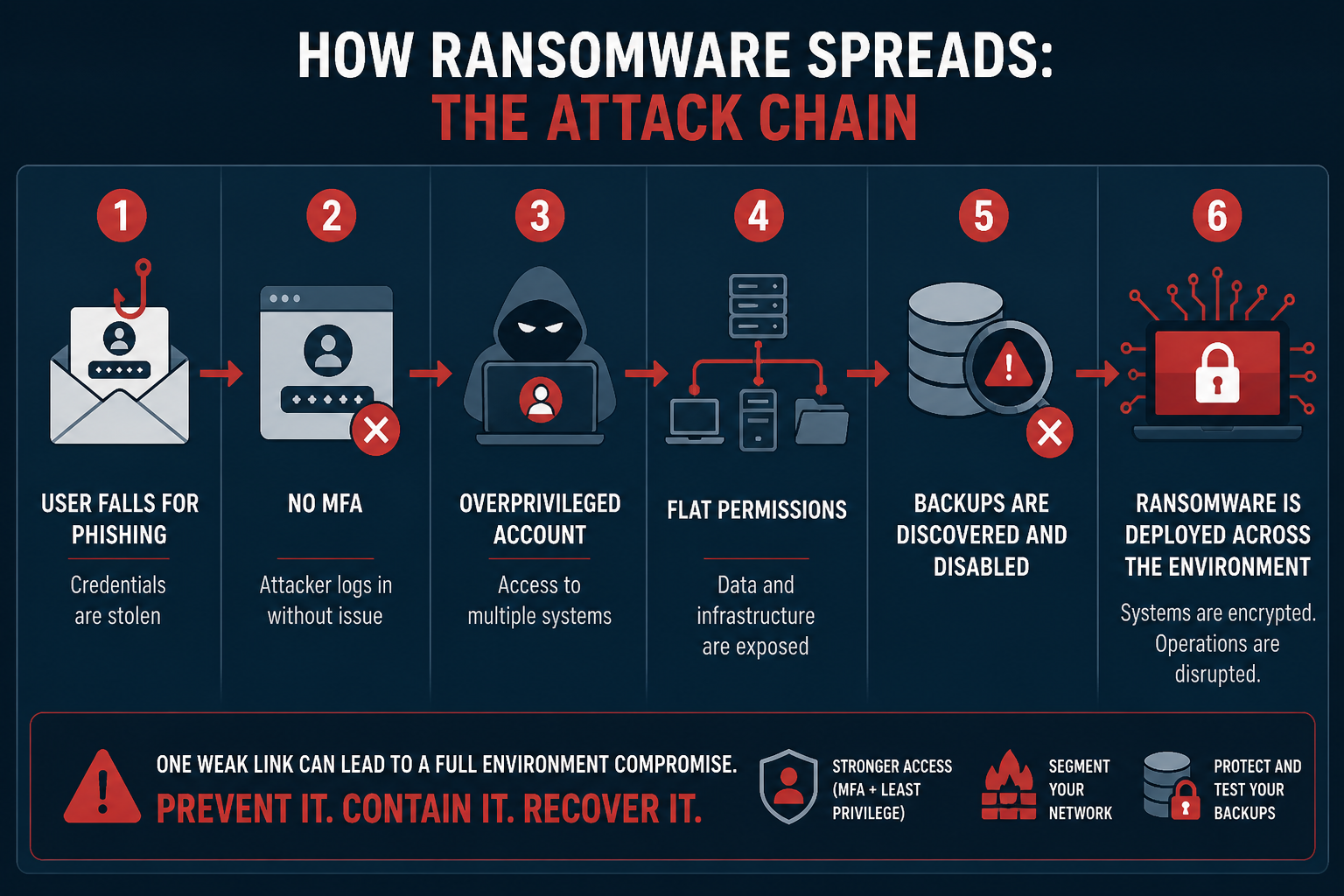
How Ransomware Spreads

The Protected Harbor Difference

Application-Aware Infrastructure: Designing for Outcomes


Security decisions aren’t neutral — they actively shape your risk. You’re not simply defending, you’re designing outcomes. All of the weaknesses we have discussed are predictable and preventable. Your environment determines the outcome before the attack starts. Treating security as an afterthought won’t put the odds in your favor in the face of an attack.


At Protected Harbor, we know security isn’t just about stopping attacks, it’s about controlling what happens when an attack occurs, not if.

Your environment determines:

  • How far an attacker can go
  • How fast they can move
  • Whether you can recover


Ransomware isn’t unpredictable. It’s opportunistic. The opportunities it finds are the ones built into your environment through decisions made long before the attack.


Protected Harbor provides Application-Aware Infrastructure in line with Zero Trust principles. Application-Aware Infrastructure is designed, operated, and optimized with a deep understanding of the application’s needs by one accountable partner. This includes:

  • 24/7 deep monitoring and custom dashboards
  • Isolated, immutable, and tested backups
  • Elevated disaster recovery options
  • MFA/ role-based access everywhere it matters
  • SOC Type 2 certification
  • Battle-tested incident response plans


Security failures happen when no one plans for outcomes and owns the infrastructure end to end. We design the infrastructure, proactively manage environments, and own the outcome. One partner. Complete accountability. Total confidence.


Framework: Is Your Organization at Risk?


Ransomware attacks feel sudden — but their success is usually the result of long-standing gaps. Weak identity controls, missing authentication layers, fragile recovery strategies — these are small gaps that compound into big risk. Environments with multiple weaknesses are not the result of bad luck, they are systems designed for failure. Organizations don’t need perfect security, but every control you add slows attackers down, limits access, and reduces the impact.


Application-Aware Infrastructure ensures your infrastructure is built around the specific needs of your application, including and especially in regard to security. The difference between disruption and disaster is rarely the attack — it’s the preparation. Building infrastructure with intentionality is the best preparation you can get.

Consider:

  • Do all privileged accounts and critical systems require MFA?
  • Are any user accounts ‘overprivileged’?
  • Are dormant accounts regularly removed?
  • Are backups isolated from your primary network?
  • Have you tested recovery in the last 6-12 months?


Contact our team for a complimentary Infrastructure Risk Assessment where we will evaluate your environment and identify:

  • Lax permissions
  • Weak or missing MFA
  • Backup vulnerabilities
  • Ransomware blast radius risk
  • Performance bottlenecks tied to infrastructure design
  • Additional areas of vulnerability


No obligation — just clarity on where you stand.