
Category: Digital Infrastructure

Architecting AI Isn’t About Models

AI, application-aware infrastructure

Architecting AI Isn’t About Models:

It’s About Owning the Infrastructure That Runs Them


There has been a significant AI boom across industries. AI used to be expensive, experimental, and limited to large applications, but things have changed, making AI much more accessible than it once was. Organizations no longer need to build AI from scratch to integrate it directly into their workflows. Because of this, many companies are eagerly looking to incorporate this technology into their applications to give them a competitive advantage. AI allows you to:

  • Respond faster
  • Personalize better
  • Operate more efficiently


The question is no longer “Should we adopt AI?”. The question is now “How do we run AI reliably, securely, and at scale?”.

Most companies are still answering that question the wrong way because they’re focusing on models. AI doesn’t fail at the model layer — it fails at the infrastructure layer.


The more AI is adopted, the more it depends on:

  • Reliable compute (especially GPUs)
  • Fast data access
  • Low-latency environments
  • Secure, governed pipelines

This is why many AI initiatives stall after early success: not because the models aren’t good enough, but because the systems running them aren’t designed for scale.


The Hidden Problem: AI as an Overlay


Most organizations have a custom application and/or workflow that is composed of either legacy or proprietary code. These kinds of applications can be difficult and slow to improve and iterate on because of the institutional knowledge required, which may no longer be available. This issue becomes even more apparent when AI is added to the mix.


Many enterprises are still approaching AI like an add-on. Models are being bolted onto fragmented environments made up of public cloud services, internal teams, and disconnected platforms. This may work in a demo, but it fails in production. This is because AI isn’t a feature you deploy, it’s an operational system you have to run.


When that system spans public cloud, private infrastructure, internal IT teams, and third-party services — fragmentation becomes the default.


This is where performance breaks down.

Costs spiral.

Accountability disappears.


Scaling AI isn’t about deploying more models — it’s about orchestrating entire ecosystems:

  • AI embedded across business operations, customer workflows, and decision systems
  • Data, identify, and policy flowing across distributed pipelines and agents
  • Workloads spanning GPUs, private cloud, edge, and hybrid environments


This is no longer a “stack”. This is a system of systems that only works when there is total ownership. If multiple vendors, platforms, and teams share responsibility, no one truly owns the outcome. This is when instability creeps in. This is also where disorganization makes it difficult to establish and document key institutional knowledge and processes.

Infrastructure Awareness Is Now Non-Negotiable


AI workloads introduce a new reality:

  • Compute is expensive and constrained
  • Latency directly impacts user experience and outcomes, not just performance metrics
  • Costs are volatile and unpredictable, particularly in shared, consumption-based environments


Yet most architectures still don’t consider infrastructure a top priority. Treating infrastructure as abstract doesn’t work anymore because AI scaling now happens across three distinct phases:

  • Pre-training scaling: Centralized, high-intensity compute
  • Post-training scaling: Distributed, data-driven adaption
  • Test-time scaling: Real-time, dynamic compute allocation


While the industry obsesses over models, the real complexity lies in where those models run, how they behave, and what happens when conditions change.

If AI is an infrastructure problem, then the solution isn’t more tools. The solution is smarter infrastructure.


Application-Aware Infrastructure: What It Means in Practice


Application-Aware Infrastructure (AAI) is built on a simple principle:

Infrastructure should understand the application — and adapt to it. Not the other way around. This shows up in five critical ways:


1.      Compute-Aware Execution

Workloads are intelligently aligned to the right resources — GPU, CPU, latency zones —across private and hybrid environments. No guesswork. No over-provisioning.

2.    Model Flexibility Without Disruption

Applications can shift between models based on performance, cost, or availability — without breaking workflows or requiring re-architecture.

3.    Built-In Retrieval & Data Awareness

RAG pipelines and data flows aren’t treated as an afterthought. They are engineered into the infrastructure and governed by performance requirements and Zero Trust security from the start.

4.    Graceful Degradation (Instead of Failure)

When constraints hit (compute limits, latency spikes, cost thresholds) systems adapt in real time:

  • Smaller models
  • Optimized queries
  • Prioritized workloads

The experience is undisturbed. The system doesn’t break.

5.    Orchestrated, Not Fragmented Systems

AI services, agents, and enterprise systems operate as a coordinated platform instead of a collection of disconnected tools competing for resources.


Real-World Examples: Application-Aware Engineering & AI


Protected Harbor is able to leverage AI from an application-aware perspective in many ways. Each of our clients has a unique application, meaning they all have unique needs. This allows us to implement AI in a range of ways that best serve our customers.

Automated Interventions

One of our clients has an application that occasionally encounters an unexpected fault due to a bespoke function. Before Protected Harbor, the client was forced to manually restart services, during which time their application would go offline. Using AI, Protected Harbor has been able to implement a ‘watchdog’ to autonomously monitor for system issues and take corrective action without requiring human intervention. This results in an immediate resolution, no perceptible impact to the client, and automated notifications to keep the team informed. This has improved uptime for the organization and reduced strain from unexpected downtime and manual intervention.

Metric Reporting & Access Requirements

Another client of ours has a very large deployment and requires frequent and accurate metric reports specific to their workflows. Protected Harbor developed automated reporting to collect specific metrics for the client’s review and decision making. Automated reporting ensures both our team and the client are working with accurate, consistent data that can be generated on demand, without needing to wait on a person.

During their migration, we also leveraged AI to automate the manipulation of users, permissions, and roles at a rapid pace to deliver on the client’s updated access requirements. This was a change that would have taken an engineer several days to complete, but was instead executed over the course of an afternoon AND had audit logging to prove its efficacy to the customer.

Common Vulnerabilities & Exposures (CVEs)

Protected Harbor’s 24/7 deep monitoring allowed us to discover a critical CVE impacting multiple customers and deployments. Protected Harbor leveraged AI to engage in a rapid response and patch all affected systems within a matter of hours. This patch included validation, reporting, and documentation to ensure minimal disruption for clients, but guaranteed application security. This allowed us to patch 6,000 endpoints in less than 30 minutes.

What Enterprises Actually Gain


When infrastructure is application-aware and fully owned, AI becomes scalable in the ways that actually matter:

  • Predictable costs: No runaway cloud spend or surprise compute spikes.
  • Performance stability: Infrastructure tuned to application behavior, not shared tenancy.
  • Resilience by design: Built-in failover, recovery, and intelligent fallback.
  • Security and governance: Zero Trust and policy enforcement at every layer.
  • Speed to Market: No friction between development, operations, and infrastructure teams.


The biggest misconception in AI architecture is that more compute equals better outcomes. The reality is that more compute without accountability creates more instability, more cost, and more risk.


Using Application-Aware Infrastructure to architect AI bridges the gap between application behavior and infrastructure execution, resulting in optimal performance, lower costs, and guaranteed long-term reliability.


Protected Harbor: The AAI Perspective


Protected Harbor designs, hosts, secures, and operates infrastructure with a deep understanding of the applications and workloads running on it — eliminating the fragmentation that causes outages, latency issues, and cost overruns.


The industry is stuck focusing on models. At Protected Harbor, we focus on where those models run, how they behave, and who is accountable when they don’t. This is because we know the most important layer is no longer the models, it’s the infrastructure decisions happening in real time.


The future of AI isn’t about infinite resources. It’s about engineering intelligent systems — and clear ownership of how they run. That requires infrastructure that is:

  • Application-aware
  • Performance tuned
  • Cost controlled
  • Fully accountable

That is what Protected Harbor delivers.


We don’t just run your infrastructure.

We understand it.

We operate.

We own the outcome.


Framework: How Well Does Your AI Run?


AI adoption is no longer optional, it’s defensive as much as it is strategic. AI is becoming popular across organizations because it now delivers:

  • Immediate productivity gains
  • Measurable cost savings
  • Competitive differentiation

But the real shift is deeper: AI is moving from experimentation to operation.

As that happens, success is less about what AI you use and more about how well you run it.


Consider:

  • Is your application being forced to adapt to generic environments?
  • Who is ultimately accountable for application and AI performance?
  • Are your costs predictable or are you dealing with frequent surprises?
  • How do your AI models perform under real-world conditions?
  • Are AI workloads tightly integrated with infrastructure or layered on top as an afterthought?


Contact the Protected Harbor team for a free AI Infrastructure Audit. No obligation — just clarity on where you stand.

When Infrastructure Becomes an Organizational Growth Multiplier

Infrastructure As Growth Multiplier Blog Banner

When Infrastructure Becomes a Growth Multiplier


Growth is crucial for any organization, but growth changes the demands placed on your systems — whether you plan for it or not. When it comes to growth, most organizations prioritize expanding their workflows and bringing on new staff/ customers. They often don’t consider how IT can play a significant role in bolstering, or inhibiting, your organizational growth.

Infrastructure is often treated as a background variable — something that either works or doesn’t. If your infrastructure simply isn’t working, then you know how your business is being impacted. However, if you don’t have an efficient system, you might not understand how this is limiting you. Infrastructure isn’t just an operational expense – it’s the foundation that determines whether growth adds friction or momentum.

As organizations grow, infrastructure quietly takes on a much bigger role. It can either become a blocker that slows progress — or a multiplier that accelerates it.

Infrastructure doesn’t necessarily become a blocker because it’s “bad”, it just may not have been designed with growth in mind. Infrastructure designed for a past version of your business can’t properly support you as your business changes and grows. As your business grows, the usage patterns, load levels, and operations expectations your system was originally designed around will change.

Computers only do what they’re programmed to do. When infrastructure isn’t architected for scale, growth introduces friction – requiring more effort, coordination, and risk just to move forward.

The design of your infrastructure is key:

  • Some environments are built to maintain.
  • Some environments are built to survive growth.
  • Some environments are built to accelerate it.


The Traditional View of Infrastructure


Infrastructure shifts from background utility to strategic determinant as organizations scale, but certain conditions are necessary to turn a cost center into a strategic enabler.

These include:

  • Self-Aware Architecture: Systems must be designed for concurrency, sustained load, and growth.
  • Predictable Performance: Uptime isn’t enough. You need a system that can adapt as your needs change and perform efficiently at all loads.
  • Alignment With Business Workflows: For optimal long-term performance, your deployment must be tailored to how your business actually operates.
  • Operational Transparency: You want to ensure your teams can trust data, tools, alerts, and performance insights.
  • Built Around Security and Compliance: Systems built with security and compliance in mind removes risk from innovation and makes audit time simpler.

Deployments with all of these variables are the strongest. Multiplier infrastructure absorbs growth and compounds progress. Combining these factors ensures you have a secure system built for scale and tailored to the unique needs of your organization.


What Growth Reveals About Your Infrastructure


Your systems might be working well enough, but uptime isn’t the only variable that matters. If you don’t have infrastructure built for scale, and if you don’t know what to look for, you could be missing key signs of growth strain.

It’s crucial for organizations to set benchmarks of bare minimum performance standards so you know when your system is performing well — and when it isn’t. This includes having a dashboard that’s tailored to the metrics that matter most for your unique workflow. A generic dashboard will tell you if your system is on or if there are major issues, but it isn’t able to evaluate performance where your users are actually feeling it.

 Business growth exposes the limitations of your architecture. A system that works decently well when you’re starting out will worsen as demands grow and change. Crashes, lags, pages that take forever to load — a system that struggles to support 100 users will barely function as you scale to 500 or 1000 users.

 Not to mention the impact this has on security and compliance. An environment that wasn’t built with security in mind is left vulnerable to cyber-attacks. This puts everything at risk — data, privacy, reputation, revenue. Deployments must also be designed around compliance standards. Otherwise, noncompliance means your organization is at risk for fines, cancellations of licenses, or even business closure.

 These are general signs that your infrastructure isn’t supporting you as well as it could, but what real-world signals tell you that your infrastructure is built to multiply growth?

 Signs that your organization is doing less firefighting — and more planning — include:

  •  Faster onboarding of new teams/applications
  • Fewer emergency tickets
  • Better time-to-market on new features
  • Predictable costs by month and quarter

Why Many Organizations Don’t Reach This Stage


 As we mentioned, IT is often not at the forefront of anyone’s mind when thinking about how to grow their business. If you don’t have architecture designed specifically for your needs and built for scalability, there are many barriers that will prevent you reaching the growth potential a strong environment could provide.

These subtle barriers include:

  • Outdated Architecture: Architecture built for yesterday’s needs can’t properly support tomorrow’s demands.
  • Debt From Legacy Platforms: Old decisions, old systems, old shortcuts that still exist in your environment — and now limit performance, flexibility, and growth.
  • Fragmented Ownership: Many organizations are stuck struggling to manage multiple third-party vendors who all have a hand in their environment.
  • Reactive Support Models: Your IT team should be focused on preventing problems, not only responding after they’ve caused disruptions.
  • Limited Performance Observability: Your organization may be able to see when something breaks, but not when performance is degrading. It’s crucial to be able to easily trace issues across infrastructure layers to identify root causes.


The Protected Harbor Perspective


Infrastructure that multiplies growth doesn’t happen by accident — it’s engineered deliberately.

At Protected Harbor, we design environments with scale as the starting assumption, not an afterthought. That means architecting for sustained load, concurrency, and evolving business demands — not just peak availability.

We believe ownership matters. By managing infrastructure, platform, and operations under a single accountable model, we eliminate fragmentation and reduce the friction that slows growing organizations.

Visibility is equally critical. Performance isn’t monitored in isolation — it’s observed across layers, allowing strain to be identified and addressed before it impacts workflow.

Capacity is planned, not reactive. Costs are predictable, environments are tailored to business realities, and growth does not require architectural reinvention.

That is what multiplier infrastructure looks like in practice.


Framework: Infrastructure Is a Strategic Asset


Growth isn’t just about revenue — it’s about capacity. Infrastructure that adapts, absorbs, and accelerates change/ growth lets organizations reach new markets, deliver innovation faster, and deliver better experiences without disruption.

Consider:

  • Does adding new customers increase momentum — or operation strain?
  • Can your infrastructure absorb growth without architectural rework?
  • Are your systems enabling speed — or requiring accommodations?

The Real Cloud Decision

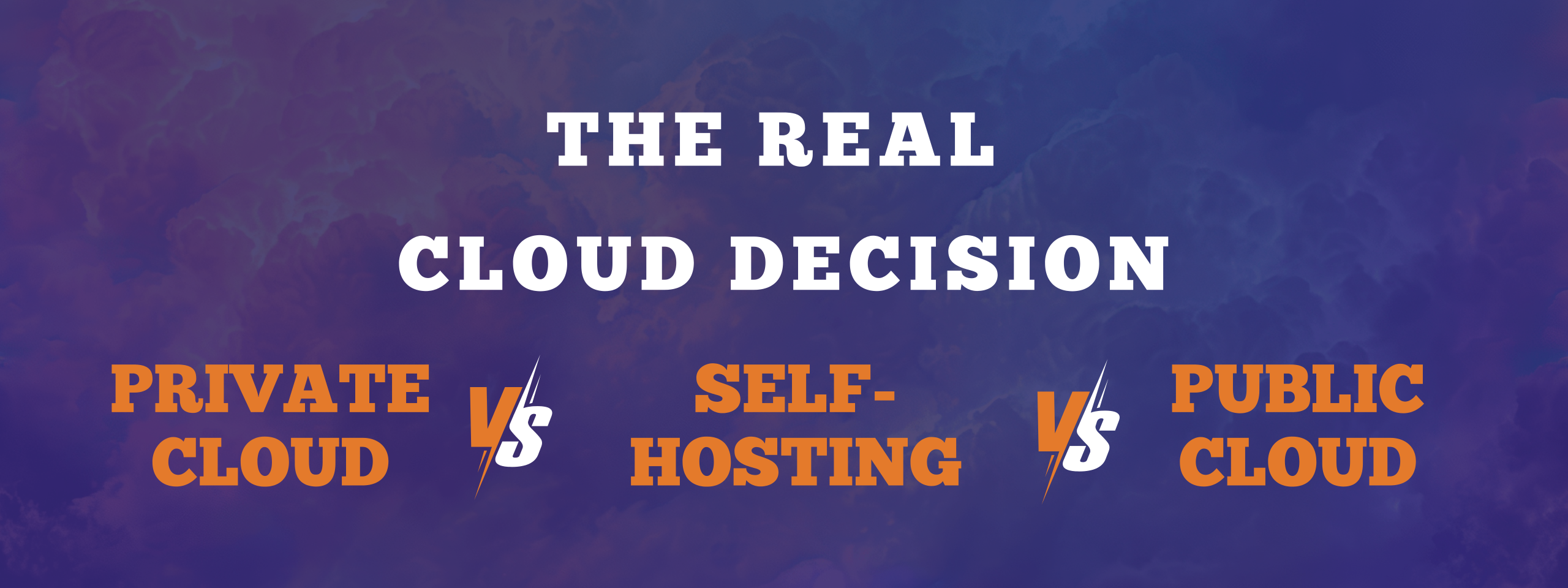
The Real Cloud Decision: Who Owns Performance, Security, & Cost?

Elasticity is Easy to Buy. Predictability, Security, & Accountability Are Not.


It’s time we rethink the cloud conversation. Most organizations prioritize convenience and elasticity when choosing their cloud environment. Both of these factors are important, but they’re not the only factors that matter. The real differences between cloud models show up over time, when performance, security, and cost become an issue. All modern cloud environments are elastic to varying degrees. The differentiator is who owns the work required to make that elasticity reliable, secure, and cost-effective.


To get the full picture, we seek to compare the different options that are out there — self-hosting, public cloud environments, and privately managed cloud environments.

What Does Self-Hosting Actually Require?


The choice between private cloud infrastructure and self-hosting is less about technology and more about risk, cost-predictability, staffing, and operational focus.


High availability

Redundant connectivity

Ransomware-protected and isolated backups

Clustered systems

Continuous monitoring

Security

Patching

Seamless updates


These features are not easy to maintain nor are they cost-effective when you self-host. In traditional on-premise environments, each of these capabilities is added piecemeal — driving up cost, complexity, and risk.


When organizations account for the full reality of on-prem infrastructure, costs escalate quickly and unpredictably. Hosting an environment requires:

  • Hardware
  • Licenses
  • Backup and security platforms
  • High-availability architecture

Along with 24/7 staff to deploy, monitor, and manage it all.


Self-Hosting vs. Private Cloud


The operating costs of a private cloud environment, such as Protected Cloud, are more predictable and don’t require upfront hardware purchases. Self-hosting, however, requires significant capital investment and recurring refresh cycles every 3-5 years. Not to mention unexpected costs related to power, cooling, maintenance, downtime, emergency replacements, and more. Sure, having total ownership seems great, but that means you have to deal with the total cost of ownership. Self-hosting also requires internal engineers and on-call coverage, meaning it comes with staffing and operational burdens that introduce key-person dependency risk.


Another thing to consider is the worst-case scenario. Certain private clouds have redundancy and disaster recovery built in, but in self-hosted environments, these features must be separately designed, funded, and maintained. Self-hosted environments also rely heavily on internal discipline and additional tooling to meet security and compliance requirements.


Not to mention the difficulties you’ll face as your companies tries to grow. Self-hosting requires purchasing and installing new hardware, often leading to capacity planning challenges that make it difficult to scale without procurement delays.


The bottom-line — self-hosting gives you complete control — but it also places the full responsibility of your environment on your shoulders alone.


Public Cloud: Tradeoffs Over Time


Public cloud environments place the burden of architecture, monitoring, and incident response on you as the customer. When incidents occur, this often requires coordination across multiple vendors while outages persist.


On top of managing complex architectures and coordinating multiple vendors, organizations also have to deal with financial uncertainty. Public cloud environments are good for elasticity and scale, but this comes at a cost. Public cloud providers offer tools that make it easy to add or subtract servers and systems, along with distributing them geographically. However, the cost of these tools is often unpredictable. Users are often charged for every bit of network traffic, disk traffic, storage usage — even private network communication between two servers.


Public cloud costs are ever growing without cost details, so organizations don’t fully understand what they’re paying for. These environments also introduce hundreds of services, pricing variables, and dependencies that increase cost uncertainty and operational complexity over time.


A major distinguisher between public cloud environments and private cloud environments is the infrastructure itself. Most cloud deployments are an empty VM. The dashboard-like nature encourages quickly spinning up resources or environments without the thought of how they all fit together. This can lead to insecure or illogical designs and wasted resources. Public cloud deployments charge you both for the resources you allocate AND the traffic moving inside your deployment between VMs. This means over-allocating resources, inefficient or busy code, and unused cloud resources all result in higher costs.


Public Cloud vs. Private Cloud


Private cloud environments like Protected Cloud provide dedicated resources sized specifically for your workloads. This ensures consistent performance without noisy-neighbor risk. Public cloud environments rely on shared infrastructure where performance can fluctuate and optimization becomes an ongoing effort.


Providing consistent, reliable performance is key for any organization. This ensures staff can get work done, customers remain happy, your reputation isn’t impacted, and profits can continue to grow. Because public clouds rely on shared infrastructure, performance can vary as workloads change and scale, requiring ongoing tuning and active management to maintain consistency over time — which are your responsibility.


When problems do occur, you have to submit a ticket to your cloud vendor and wait for a response. Sometimes you’ll be directed to a status page with updates about ongoing issues, but often you’re stuck waiting and have to hope that whatever response you get is helpful.


Another issue that arises with public cloud environments is misalignment with security and compliance. Protected Cloud is a private cloud environment built with a compliance-first design, while public cloud security follows a shared-responsibility model. This often leads to confusion, misconfiguration, and additional consulting costs.


The bottom-line — public cloud environments are great for elasticity and scalability — but private cloud environments are the better long-term solution for stability, cost predictability, and security.

The Protected Cloud Difference


Protected Cloud offered by Protected Harbor is a privately managed cloud environment. Protected Cloud brings together deep infrastructure and hosting expertise with DevOps and programming support to deliver a secure, flexible, and well-governed platform.


It’s designed for organizations that need:

  • Predictable costs
  • Strong security
  • Hands-on operational support


Protected Cloud is purpose-built for steady workloads, compliance-driven environments, and long-term operational stability.


With Protected Cloud, infrastructure, platform, and operations are actively monitored and managed 24/7 by a single accountable partner whose job is to prevent outages before they can impact your business. Stuck updates, runaway jobs, and resource contention are identified and addressed in minutes by experienced engineers, restoring systems quickly and avoiding prolonged downtime and reputational damage.


Infrastructure, operations, and support are all under one reliable partner offering fixed, transparent pricing — eliminating unpredictable usage spikes and cost uncertainty.


Protected Cloud offers:

  • Clear monthly costs
  • Dedicated resources tailored to your organization’s specific workflow
  • Clear accountability for security control and simpler audit processes
  • Reduced architectural complexity, making onboarding and long-term management easier


Self-hosting maximizes control but it also maximizes responsibility. Protected Cloud delivers private infrastructure benefits without the staffing risk, capital exposure, and operational complexity of self-hosting.


Public cloud and private cloud environments are both elastic. Protected Cloud differentiates itself through predictable cost, dedicated resources, and clear accountability. Protected Cloud is the better platform for organizations prioritizing long-term stability, security, and a true managed partnership.


At Protected Harbor, we care deeply about the success of our clients and fostering strategic partnerships. We offer private infrastructure without the private infrastructure burden, along with the skillset and flexibility to scale an environment, all at an upfront cost.


Framework: How Does Cloud Hosting Impact You?


Self-hosting and public clouds both have their own unique benefits — along with their downfalls. Protected Cloud exists as a middle path, providing your organization with the control and privacy of private cloud environments, along with the elasticity common to public clouds, but without the cost uncertainty or the burden of full responsibility weighing on your shoulders.


Consider:

  • What type of cloud environment does your organization currently use?
  • Is this cloud environment meeting your needs?
  • Do you feel that what you’re getting is worth what you’re paying for?
  • Are costs predictable?

Performance Is a Business Metric Now

Performance Is a Business Metric Now

Performance Is a Business Metric Now


Why Speed, Responsiveness, & Throughput Shape Real Business Outcomes

Have you ever been working to meet a deadline when suddenly, your computer crashes? Maybe you’re able to get it back up and running, but your applications are taking too long to load, so now you’re fighting against time and a system that won’t function the way you need it to.

These seemingly minor technical issues might not appear to be a big deal in the long run, but they can significantly impact your business advantage. Performance isn’t just a technical metric. It’s the ability to get work done and scale your business as you take on new customers. An application or architecture that can accommodate the growth of your company allows you to focus on revenue, not IT. This is the kind of challenge Protected Harbor is built to tackle.


The Problem

When performance is treated as an IT concern instead of a business behavior, organizations feel the effects long before they recognize the cause. The first step to acknowledging a performance issue is defining your metrics.  

Let’s consider radiology.

Images generated during radiology can be quite large in size. Certain imaging, such as MRIs, take up a substantial amount of disk space and have long retention periods to comply with the strict regulations of the medical field. As a practice grows, this issue only gets worse.

If an organization lacks proper IT staffing and knowledge, their inability to scale the environment can result in insufficient performance to maintain an increasing number of concurrent scans. Radiology infrastructure requires a very thoughtfully designed network to transmit large amounts of sensitive data to a single location.

Another issue to consider is where these images are being stored. You need to scale the environment to accommodate growth. As you do this, it’s also important to have a clear understanding of how the different components in your deployment should be operating.

Performance is often discussed abstractly, while businesses feel the effects of poor performance concretely. Organizations can’t always articulate why or when something occurs, but you know the business impact of a poorly performing tool.

Maybe a medical imaging organization can tell images aren’t sending as expected and people are wasting valuable time on troubleshooting issues, but without a clearly defined benchmark for performant operations, it’s not clear how poor their performance really is.

This lack of benchmark and knowledge can lead to insufficient backups and protections against infection/ ransomware, along with an incomplete understanding of where to move next. If you can’t clearly define your issues, you can’t plan on resolving them and don’t know how to prioritize a resolution.

Degraded performance can result in HIPAA non-compliance. If backups aren’t running as expected or operating efficiently, the organization can be at compliance risk in the event of an attack. This issue may start out as an IT concern but can evolve into a critical business exposure.

When systems hesitate, work slows. If you feel like your customers or patients are waiting on you because you’re waiting on your systems, you might want to examine how much this is hurting your business. If it’s taking longer for employees to input and manage their application data, it’s taking longer to get a return on your investment and business.

The Business Impact

Speed determines how quickly work can begin or resume.

Responsiveness determines whether that work continues smoothly when high-stress, real-world conditions change.

Throughput determines how much your business can actually accomplish over time.

Together, these three factors quietly define capacity not in theory, but in day-to-day execution. They have a major impact on your reputation and ability to scale your business to take on new customers.

For example, slow PACS load times cause delays that may not directly impact the patient experience, however, they do impact how long it takes for radiologists to read and process studies. If delays are significant, it could cause in-demand radiologists to leave your practice. PACS performance is a requirement for radiologists to consider working for an organization. Poor performance can impact if these workers want to continue reading for your organization.

Systems running slow means radiologists are unhappy, you’re losing the staff you need, and doctors are running behind. The patient is left waiting for the imaging to do its job, impacting diagnoses and the patient experience. When your staff and your patients are left frustrated and unsatisfied, your reputation and profits are on the line.


Why This Keeps Happening

How does your organization define your metrics?

What is performance to you? Log-ins per hour? Loading times? How many times a specific request can be completed? These metrics may look fine, so then why do performance issues persist? This is because performance is often measured in isolation and systems are often designed for uptime, instead of real-world demands.

If you don’t have an answer to these questions, consider that teams rarely pause to evaluate performance when they’re operating beyond capacity. When things are busy, the focus tends to be on getting through the day rather than stepping back to assess how well your systems are actually supporting the work that needs to get done.

Your uptime may seem adequate, but how is your system performing when it’s actually being used? Systems hesitate under heavy loads, teams are waiting on a response, incidents aren’t being documented — your capacity is shrinking quietly, but alarms aren’t being raised because you may not know what to look for outside of a clear system failure.

Even if the system is up and running and nothing appears broken, delays slow down work.

Tasks build up.

Demand spikes.

Employees are scrambling.

Customers are unsatisfied.

As an executive, you probably recognize these experiences before anyone realizes it’s a performance problem.

At Protected Harbor, when we deploy your environment, our engineers take the time to architect a performant, scalable deployment that meets your unique needs. Some critical choices we make in this process center around:

  • Designing efficient networks capable of handling large volumes of traffic without incurring hidden fees or latency
  • Ensuring that deployments have adequate resources to be performant today, and then using our in-house monitoring to make sure it stays that way tomorrow
  • Working collaboratively to introduce high-availability wherever possible and eliminate single points of failure

The Protected Harbor Difference

Performance Is a Business Metric Now

Performance must be engineered, not tuned.

Creating a system tailored to the needs of your organization allows issues to be solved quickly and prevent them from happening in the first place. Good performance happens when your infrastructure is shaped around how your work flows.

Small performance gains might not mean much in the moment, but they compound over time. Consistent, reliable experiences with applications means a positive reputation.

These consistent wins build on each other, avoiding disruptions and ensuring your performance grows steadily.

When performance grows, you see increases in:

  • Productivity
  • Employee morale
  • Customer or patient satisfaction
  • Reputation
  • Profits

Your organization needs a Managed Service Provider who will take the time to understand your environment and your unique needs. At Protected Harbor, our engineers will come in, thoroughly evaluate your environment to identify problem areas and areas of improvement, and collaborate with you to design a custom application deployment that can scale with your business needs.

Our engineers know our system inside and out because we’re the ones who built it. This gives us the control and accountability to create a system tailored to the evolving needs of each client. Protected Harbor helps companies run IT like a business KPI — better uptime, better performance, lower cost, and less risk.


Framework: Performance Is the Product

Performance is no longer just an IT metric — it is a crucial business metric executives should care about.

Consider:

  • Has my reputation been impacted by a degraded application experience?
  • Have I been unable to scale or grow parts of my business due to architectural limitations?
  • Do I have clear, defined ways to measure and understand changes within my application?
  • How much revenue has been lost because systems aren’t running up to date or you don’t have the best optimizations for your hardware?

Speed + Responsiveness +Throughput = Optimal Business Capacity