
Ransomware Risk Is Designed

Ransomware Risk is Designed

Ransomware Risk Isn’t Random — It’s Designed by Your Environment


Most cyberattacks don’t need to rely on advanced exploits. Many successful incidents rely on exploiting predictable, preventable internal weaknesses. Attackers don’t need to outsmart your defenses — they can just look for:

  • Weak or missing authentication controls
  • Excessive access once inside
  • The ability to destroy recovery options


These are not edge cases — they’re common operational gaps. Ransomware success isn’t about how advanced the attacker is — it’s about how exposed your environment is. Ransomware doesn’t succeed because an attacker got lucky. It succeeds because the environment allowed it to succeed. Ransomware follows the path you’ve already built. Attackers don’t need to create complexity when they can just exploit what’s already there.


In our previous blogs, we looked at how mixed-use servers and flat networks increase your vulnerability to ransomware. In this blog, we are going to focus on common identity/ access weaknesses, and why protecting your backups is one of the most crucial ways to save your business.


The Keys to the Kingdom


Organizations must properly manage user accounts and be mindful of excessive permissions. If one account can access everything, one compromise can destroy everything. Mismanaged accounts and permissions can look like:

  • Users with access far beyond their job function
  • Service accounts with domain-level privileges
  • Shared admin credentials across teams
  • Wide-open file shares
  • Dormant accounts still active


Many environments evolve over time without governance, which can lead to permission creep, forgotten accounts, and inconsistent access policies. These issues also occur when an organization is coordinating multiple vendors and there is no clear ownership. Once an attacker gains any valid credentials, they can blend in as a legitimate user, avoid detection by security tools, and move faster than traditional defenses can react.


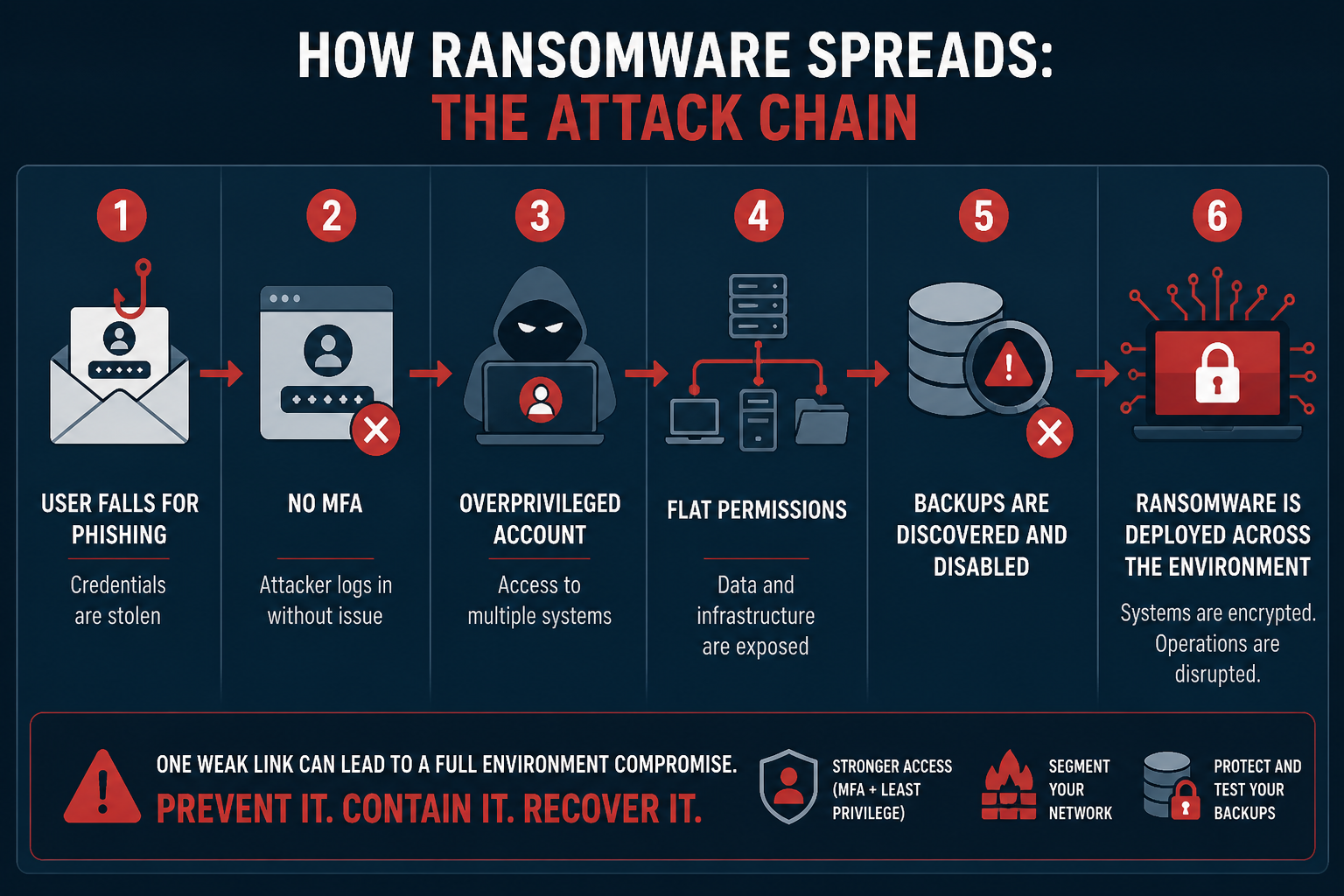
If an attacker obtains access to an ‘overprivileged’ account, you’re essentially giving them the keys to the kingdom. This broad access means attackers don’t need to hack your systems to wreak havoc — all they need to do is log in.

Once in, attackers will:

  • Use stolen credentials to access multiple systems
  • Escalate privileges using misconfigurations
  • Move laterally without triggering alarms
  • Quickly access sensitive data and critical systems


Authentication = trust. If identity controls are weak, attackers can inherit that trust.


Hidden Risks & How to Prevent Them


Hidden risks include:

  • Dormant accounts: Old employees, contractors, test accounts.
  • Shadow IT: Accounts created outside of IT oversight.
  • Lack of access reviews: Permissions are never reevaluated.
  • Flat directory structures: No separation of privilege tiers.
  • Wide-open share permissions: “Everyone” or “Domain Users” can access critical shares.


All of these risk factors create an easy staging ground for ransomware encryption.


What to do instead:

  • Enforce least privilege (only what’s needed, nothing more)
  • Conduct regular access reviews
  • Automate processes for employees who join, move, or leave
  • Segment administrative roles
  • Lock down shared resources with clear ownership


Ransomware Doesn’t Need to Break In — It Logs In & Spreads


Let’s see an example. An organization tends to be lax with their permissions, but their security is otherwise strong. A user unknowingly clicks on a malicious link, introducing malware into the environment. Once inside the environment, the attackers focus on getting access to local admin so they can extend that access to the entire deployment. This is known as escalation of privilege. If the organization does not utilize deep monitoring, they might not be alerted to suspicious activity in their environment. By the time they realize, it may already be too late. Once an organization is locked out of their deployment, an attacker may deploy ransomware or scan the deployment for sensitive information (e.g., social security numbers, payment information, files that contain keywords like ‘password’ in the name).


Attackers always target data because data is currency. Once your data is within their grasp, they can steal it, sell it, hold it for ransom — your entire organization will be jeopardized.

The Open Door Problem


Passwords alone are not enough. This is because passwords are often reused across systems, easily phished, and frequently exposed in breaches. Attackers heavily rely on phishing campaigns, credential stuffing, and password spraying because these methods require minimal effort with a high success rate.


Multi-factor authentication (MFA) introduces a second factor, creating a barrier than can block most automated attacks. Even if credentials are compromised, attackers can’t log in without the second factor (for example, validating a log-in attempt with an authenticator app). Without MFA, stolen credentials are often all attackers need: you’re leaving the door open for hackers to walk right in.


MFA isn’t a silver bullet, but it can stop the vast majority of opportunistic attacks. Using MFA isn’t about being unbreakable, it’s about:

  • Increasing effort for attackers
  • Reducing attack success rates
  • Creating additional detection opportunities


Roll out MFA for email systems, remote access (VPNs), and administrative accounts. App-based authenticators should be used over SMS when possible. Risk-based/ adaptive MFA takes this a step further by evaluating the circumstances around a login attempt (device posture, location, IP reputation, login behavior, etc.) before granting access. It’s also key to educate your users so that they know to never approve unexpected prompts.


The Final Line of Defense


The harsh reality is that modern ransomware doesn’t just encrypt data, it targets backups first, disables recovery mechanisms, and exfiltrates data for double extortion. Common backup mistakes include:

  • Backups connected to the same domain
  • Always-online backup systems
  • Shared credentials between production and backup environments
  • No immutability


Backups are your last line of defense — these mistakes make backups discoverable, accessible, and destroyable.


When backups fail, downtime increases dramatically, ransomware pressure rises, and recovery becomes slow, partial, or impossible. A strong backup strategy looks like:

  • Immutable backups: Cannot be altered or deleted.
  • Offline/ air-gapped copies: Not accessible from the production network.
  • Separate credentials/ domains: Limits an attacker’s access.
  • Multiple backup tiers: Onsite + offsite.
  • Testing: Many organizations perform backups regularly, but never test restores.


Testing is one of the most skipped, and arguably most critical, steps. Testing is key for verifying data integrity, ensuring systems can actually be rebuilt, identifying gaps in the recovery process, and reducing panic during real incidents. A backup that hasn’t been tested is an assumption — not a solution.


From One Login to Total Shutdown


The critical business reality is that organizations who cannot recover quickly lose significant revenue, lose customer trust, and if the attack is bad enough, have to shut down entirely. This is why a multi-layered approach is crucial for protecting yourself against cyber threats. You want to ensure that if one layer of protection goes down, the others will be there to hold the line of defense. If not, you’re completely exposed. Organizations must understand that implementing layers of defense doesn’t happen randomly, it has to be designed.


Flat networks, mixed-use servers, mismanaged permissions, missing MFA, backup mistakes — these failures don’t happen by accident. Implementing layers of protection takes conscious thought, planning, and effort.  That is why it is so important to have infrastructure that is application-aware and built with security top of mind. Individually, each of these failures are risky. Combined, they create a near-guaranteed path to full business disruption.

No single failure causes the breach, but the damage can be catastrophic when you lack:

  • Layered defenses
  • Containment
  • Recovery capabilities


How Ransomware Spreads

The Protected Harbor Difference

Application-Aware Infrastructure: Designing for Outcomes


Security decisions aren’t neutral — they actively shape your risk. You’re not simply defending, you’re designing outcomes. All of the weaknesses we have discussed are predictable and preventable. Your environment determines the outcome before the attack starts. Treating security as an afterthought won’t put the odds in your favor in the face of an attack.


At Protected Harbor, we know security isn’t just about stopping attacks, it’s about controlling what happens when an attack occurs, not if.

Your environment determines:

  • How far an attacker can go
  • How fast they can move
  • Whether you can recover


Ransomware isn’t unpredictable. It’s opportunistic. The opportunities it finds are the ones built into your environment through decisions made long before the attack.


Protected Harbor provides Application-Aware Infrastructure in line with Zero Trust principles. Application-Aware Infrastructure is designed, operated, and optimized with a deep understanding of the application’s needs by one accountable partner. This includes:

  • 24/7 deep monitoring and custom dashboards
  • Isolated, immutable, and tested backups
  • Elevated disaster recovery options
  • MFA/ role-based access everywhere it matters
  • SOC Type 2 certification
  • Battle-tested incident response plans


Security failures happen when no one plans for outcomes and owns the infrastructure end to end. We design the infrastructure, proactively manage environments, and own the outcome. One partner. Complete accountability. Total confidence.


Framework: Is Your Organization at Risk?


Ransomware attacks feel sudden — but their success is usually the result of long-standing gaps. Weak identity controls, missing authentication layers, fragile recovery strategies — these are small gaps that compound into big risk. Environments with multiple weaknesses are not the result of bad luck, they are systems designed for failure. Organizations don’t need perfect security, but every control you add slows attackers down, limits access, and reduces the impact.


Application-Aware Infrastructure ensures your infrastructure is built around the specific needs of your application, including and especially in regard to security. The difference between disruption and disaster is rarely the attack — it’s the preparation. Building infrastructure with intentionality is the best preparation you can get.

Consider:

  • Do all privileged accounts and critical systems require MFA?
  • Are any user accounts ‘overprivileged’?
  • Are dormant accounts regularly removed?
  • Are backups isolated from your primary network?
  • Have you tested recovery in the last 6-12 months?


Contact our team for a complimentary Infrastructure Risk Assessment where we will evaluate your environment and identify:

  • Lax permissions
  • Weak or missing MFA
  • Backup vulnerabilities
  • Ransomware blast radius risk
  • Performance bottlenecks tied to infrastructure design
  • Additional areas of vulnerability


No obligation — just clarity on where you stand.
Architecting AI Isn’t About Models

AI, application-aware infrastructure

Architecting AI Isn’t About Models:

It’s About Owning the Infrastructure That Runs Them


There has been a significant AI boom across industries. AI used to be expensive, experimental, and limited to large applications, but things have changed, making AI much more accessible than it once was. Organizations no longer need to build AI from scratch to integrate it directly into their workflows. Because of this, many companies are eagerly looking to incorporate this technology into their applications to give them a competitive advantage. AI allows you to:

  • Respond faster
  • Personalize better
  • Operate more efficiently


The question is no longer “Should we adopt AI?”. The question is now “How do we run AI reliably, securely, and at scale?”.

Most companies are still answering that question the wrong way because they’re focusing on models. AI doesn’t fail at the model layer — it fails at the infrastructure layer.


The more AI is adopted, the more it depends on:

  • Reliable compute (especially GPUs)
  • Fast data access
  • Low-latency environments
  • Secure, governed pipelines

This is why many AI initiatives stall after early success: not because the models aren’t good enough, but because the systems running them aren’t designed for scale.


The Hidden Problem: AI as an Overlay


Most organizations have a custom application and/or workflow that is composed of either legacy or proprietary code. These kinds of applications can be difficult and slow to improve and iterate on because of the institutional knowledge required, which may no longer be available. This issue becomes even more apparent when AI is added to the mix.


Many enterprises are still approaching AI like an add-on. Models are being bolted onto fragmented environments made up of public cloud services, internal teams, and disconnected platforms. This may work in a demo, but it fails in production. This is because AI isn’t a feature you deploy, it’s an operational system you have to run.


When that system spans public cloud, private infrastructure, internal IT teams, and third-party services — fragmentation becomes the default.


This is where performance breaks down.

Costs spiral.

Accountability disappears.


Scaling AI isn’t about deploying more models — it’s about orchestrating entire ecosystems:

  • AI embedded across business operations, customer workflows, and decision systems
  • Data, identify, and policy flowing across distributed pipelines and agents
  • Workloads spanning GPUs, private cloud, edge, and hybrid environments


This is no longer a “stack”. This is a system of systems that only works when there is total ownership. If multiple vendors, platforms, and teams share responsibility, no one truly owns the outcome. This is when instability creeps in. This is also where disorganization makes it difficult to establish and document key institutional knowledge and processes.

Infrastructure Awareness Is Now Non-Negotiable


AI workloads introduce a new reality:

  • Compute is expensive and constrained
  • Latency directly impacts user experience and outcomes, not just performance metrics
  • Costs are volatile and unpredictable, particularly in shared, consumption-based environments


Yet most architectures still don’t consider infrastructure a top priority. Treating infrastructure as abstract doesn’t work anymore because AI scaling now happens across three distinct phases:

  • Pre-training scaling: Centralized, high-intensity compute
  • Post-training scaling: Distributed, data-driven adaption
  • Test-time scaling: Real-time, dynamic compute allocation


While the industry obsesses over models, the real complexity lies in where those models run, how they behave, and what happens when conditions change.

If AI is an infrastructure problem, then the solution isn’t more tools. The solution is smarter infrastructure.


Application-Aware Infrastructure: What It Means in Practice


Application-Aware Infrastructure (AAI) is built on a simple principle:

Infrastructure should understand the application — and adapt to it. Not the other way around. This shows up in five critical ways:


1.      Compute-Aware Execution

Workloads are intelligently aligned to the right resources — GPU, CPU, latency zones —across private and hybrid environments. No guesswork. No over-provisioning.

2.    Model Flexibility Without Disruption

Applications can shift between models based on performance, cost, or availability — without breaking workflows or requiring re-architecture.

3.    Built-In Retrieval & Data Awareness

RAG pipelines and data flows aren’t treated as an afterthought. They are engineered into the infrastructure and governed by performance requirements and Zero Trust security from the start.

4.    Graceful Degradation (Instead of Failure)

When constraints hit (compute limits, latency spikes, cost thresholds) systems adapt in real time:

  • Smaller models
  • Optimized queries
  • Prioritized workloads

The experience is undisturbed. The system doesn’t break.

5.    Orchestrated, Not Fragmented Systems

AI services, agents, and enterprise systems operate as a coordinated platform instead of a collection of disconnected tools competing for resources.


Real-World Examples: Application-Aware Engineering & AI


Protected Harbor is able to leverage AI from an application-aware perspective in many ways. Each of our clients has a unique application, meaning they all have unique needs. This allows us to implement AI in a range of ways that best serve our customers.

Automated Interventions

One of our clients has an application that occasionally encounters an unexpected fault due to a bespoke function. Before Protected Harbor, the client was forced to manually restart services, during which time their application would go offline. Using AI, Protected Harbor has been able to implement a ‘watchdog’ to autonomously monitor for system issues and take corrective action without requiring human intervention. This results in an immediate resolution, no perceptible impact to the client, and automated notifications to keep the team informed. This has improved uptime for the organization and reduced strain from unexpected downtime and manual intervention.

Metric Reporting & Access Requirements

Another client of ours has a very large deployment and requires frequent and accurate metric reports specific to their workflows. Protected Harbor developed automated reporting to collect specific metrics for the client’s review and decision making. Automated reporting ensures both our team and the client are working with accurate, consistent data that can be generated on demand, without needing to wait on a person.

During their migration, we also leveraged AI to automate the manipulation of users, permissions, and roles at a rapid pace to deliver on the client’s updated access requirements. This was a change that would have taken an engineer several days to complete, but was instead executed over the course of an afternoon AND had audit logging to prove its efficacy to the customer.

Common Vulnerabilities & Exposures (CVEs)

Protected Harbor’s 24/7 deep monitoring allowed us to discover a critical CVE impacting multiple customers and deployments. Protected Harbor leveraged AI to engage in a rapid response and patch all affected systems within a matter of hours. This patch included validation, reporting, and documentation to ensure minimal disruption for clients, but guaranteed application security. This allowed us to patch 6,000 endpoints in less than 30 minutes.

What Enterprises Actually Gain


When infrastructure is application-aware and fully owned, AI becomes scalable in the ways that actually matter:

  • Predictable costs: No runaway cloud spend or surprise compute spikes.
  • Performance stability: Infrastructure tuned to application behavior, not shared tenancy.
  • Resilience by design: Built-in failover, recovery, and intelligent fallback.
  • Security and governance: Zero Trust and policy enforcement at every layer.
  • Speed to Market: No friction between development, operations, and infrastructure teams.


The biggest misconception in AI architecture is that more compute equals better outcomes. The reality is that more compute without accountability creates more instability, more cost, and more risk.


Using Application-Aware Infrastructure to architect AI bridges the gap between application behavior and infrastructure execution, resulting in optimal performance, lower costs, and guaranteed long-term reliability.


Protected Harbor: The AAI Perspective


Protected Harbor designs, hosts, secures, and operates infrastructure with a deep understanding of the applications and workloads running on it — eliminating the fragmentation that causes outages, latency issues, and cost overruns.


The industry is stuck focusing on models. At Protected Harbor, we focus on where those models run, how they behave, and who is accountable when they don’t. This is because we know the most important layer is no longer the models, it’s the infrastructure decisions happening in real time.


The future of AI isn’t about infinite resources. It’s about engineering intelligent systems — and clear ownership of how they run. That requires infrastructure that is:

  • Application-aware
  • Performance tuned
  • Cost controlled
  • Fully accountable

That is what Protected Harbor delivers.


We don’t just run your infrastructure.

We understand it.

We operate.

We own the outcome.


Framework: How Well Does Your AI Run?


AI adoption is no longer optional, it’s defensive as much as it is strategic. AI is becoming popular across organizations because it now delivers:

  • Immediate productivity gains
  • Measurable cost savings
  • Competitive differentiation

But the real shift is deeper: AI is moving from experimentation to operation.

As that happens, success is less about what AI you use and more about how well you run it.


Consider:

  • Is your application being forced to adapt to generic environments?
  • Who is ultimately accountable for application and AI performance?
  • Are your costs predictable or are you dealing with frequent surprises?
  • How do your AI models perform under real-world conditions?
  • Are AI workloads tightly integrated with infrastructure or layered on top as an afterthought?


Contact the Protected Harbor team for a free AI Infrastructure Audit. No obligation — just clarity on where you stand.
From Incidents to Outages: The Cost of Getting It Wrong

Why One Compromised Machine Can Take Down Your Entire Organization


Most organizations know cyberattacks are a serious threat, but they don’t fully understand why. Attackers keep evolving and finding new ways to target businesses, so we must always be on alert for new ways to protect ourselves. There is no single cause of a ransomware attack, which is why organizations must use a multi-layered approach to protect themselves. Most organizations think ransomware is a security failure. In actuality, it’s an infrastructure design failure. In our last blog, we looked at how mixed-use servers increase your vulnerability to ransomware. Today, we’re going to look at how flat networks don’t just allow attacks to happen — they accelerate them.


What Are Flat Networks?


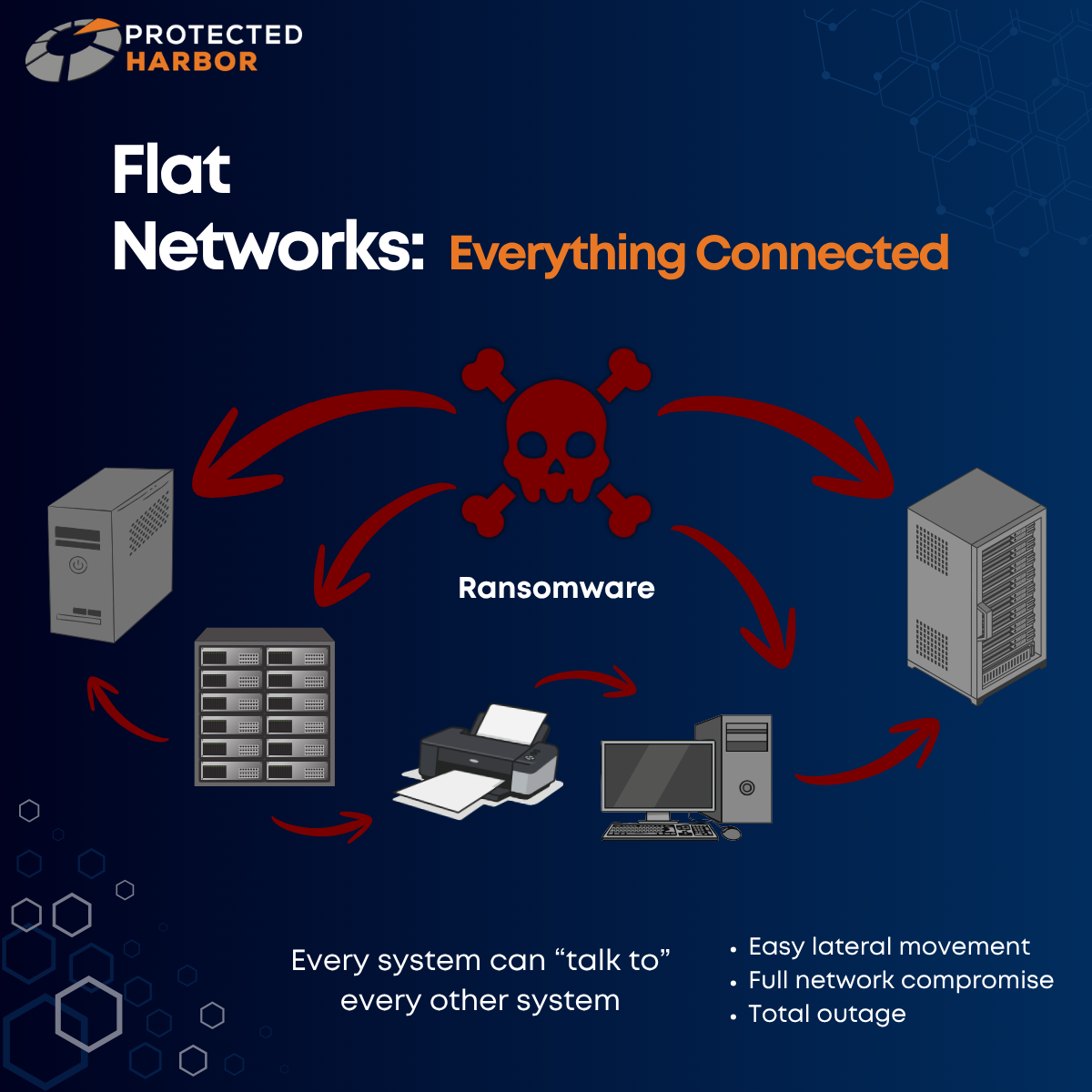
A flat network is one with minimal internal boundaries between systems. Think of flat networks as an open office with no doors.

In these environments:

  • Every system can talk to every other system
  • Application layers are not isolated
  • Data flows are not controlled
  • Dependencies are not understood


From the outside, everything may look operational, but underneath? There’s no structure. No boundaries. No awareness.

Just connectivity.


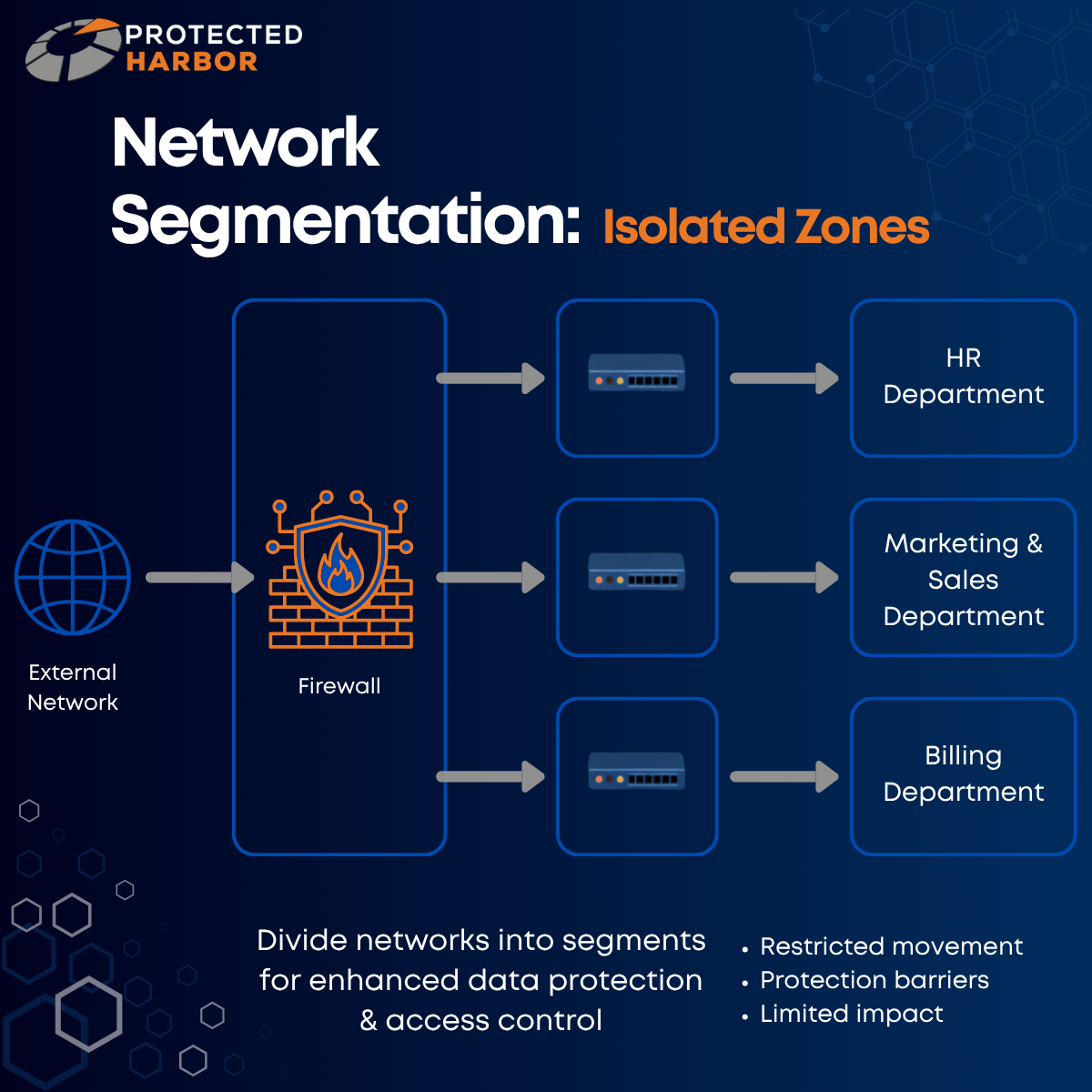
To avoid a flat network, you need network segmentation. Network segmentation divides a single network into different segments to enhance data protection and control access. Segmented networks can be thought of as a secured office building with badge-controlled rooms.

From Incidents to Outages: The Cost of Getting It Wrong


One of the hardest parts for an attacker is actually getting into your system:

Crafting an email that looks legitimate to trick someone into clicking a malicious download link.

Finding their way into exposed remote desktop access.

Exploiting a public Wi-Fi network.


But once they’re in? It’s go time. When a single compromised machine can take down your entire organization, the real issue isn’t how the attacker got in — it’s how far they were allowed to go once they did. During an attack, minutes and hours matter more than almost anything else. Slowing the spread of malware increases your chances of early detection, isolating key systems, and preventing the full deployment from being impacted.


If a fire breaks out in a dense forest, the entire forest will burn quickly and uncontrollably. If an attacker gains access to a network with little to no segmentation, there is no barrier to movement. The consequence?

Ransomware will spread in minutes, not hours.


Not only can the ransomware spread quicker, but it’s easier for attackers to access high-value systems like your file servers, backups, and domain controllers. The issue here is lateral movement. The initial breach is often small, but the damage becomes massive due to internal spread. In this context, segmentation would be firebreaks (strips of land where trees and vegetation are removed in order to stop or slow the spread of a fire). They won’t prevent fires from starting, but they contain the damage.


Why Segmentation Failures Lead to Total Outages


When ransomware hits a flat network, your entire environment will be encrypted simultaneously and you’ll have a full outage on your hands within hours. This means a full operational shutdown, longer recovery timelines, and a higher pressure to pay the ransom.


When an attacker breaches a flat network, they don’t need to break in again. They can freely move from:

  • User device to application server
  • Application server to database
  • Database to backups
  • Backups to domain control

Your infrastructure is allowing unrestricted traversal across systems that were never meant to be exposed to each other.


Segmentation often determines whether a ransomware attack means one department is down, or the entire company goes offline. Every minute of downtime caused by an attack hurts your organization.

Frustrated customers.

Idle staff.

Missed transactions.

Lost revenue.

Reputational damage.

Increased risk of lawsuits and fines.


When one system goes down? That’s manageable.

When everything goes down? The fate of your entire organization is on the line.


The worse the spread, the longer you’ll be offline. The longer your operations are shut down or you’re without access to your data, the higher the chances are that you’ll never recover. Organizations experiencing data loss for more than 10 days face a 93% bankruptcy rate within a year of a cyberattack. Ransomware can cripple your business if you’re not actively taking steps to ensure you’re protected. Segmentation slows attacks down, limits the blast radius, and buys time for detection and response. In the aftermath, it also makes recovery faster, more contained, and less costly.


How Do Flat Networks Occur?


Flat networks are the result of:

  • Organic growth without architectural oversight
  • Multiple vendors with no single point of accountability
  • “Get it working” decisions that are never revisited
  • A lack of understanding of application behavior


No one designs bad infrastructure on purpose, but flat networks aren’t accidental. Segmentation is an architectural decision. It doesn’t require specialized hardware, you just need to be thinking about it. Flat networks happen when infrastructure is built generically, often due to a lack of expertise. Many organizations end up with a flat network simply because they, or their IT team, don’t know any better.


Segmentation is how you define the boundaries of your application. Common segmentation mistakes include:

  • Overly permissive firewall rules
  • Backup systems on the same network as production
  • Not restricting admin pathways
  • Shared credentials between systems
  • Leaving default accounts enabled
  • Allowing users to install and manage software


As attackers continue to develop new and increasingly advanced methods, this has led to Zero Trust becoming a focus in the industry when it comes to security principles. Zero Trust operates on the idea that you never blindly trust anything in an environment. You must always authenticate and verify every single action and/or change. Zero Trust means that IT teams can no longer operate on implicit trust — they must operate on explicit trust.

How Segmentation Can Save Your Business

In well-engineered environments, segmentation isn’t a feature — it’s built into how the application is structured, accessed, and operated.


The difference between an incident and a disaster is often just a few barriers.


Segmentation works by dividing your systems into isolated zones, adding control, visibility, and security together. Barriers, such as firewalls, access control lists (ACLs), or role-based access control (RBAC), are used to restrict movement so in the event of a cyberattack, attackers can’t freely jump between systems.


Let’s go back to our forest fire example. If a fire begins to spread in one section (such as a compromised laptop), it will spread locally until it hits a barrier. During a cyberattack, this means the ransomware can’t easily cross into server environments, backup systems, or critical infrastructure. The result? Only a portion of the “forest” burns, but the rest remains intact while the firefighters (your security team) have time to respond and mitigate further damage.


You can’t prevent every attack, but you can prevent total destruction. Segmentation isn’t about perfection; it’s about having layers of protection to:

  • Reduce the blast radius
  • Keep incidents manageable
  • Avoid catastrophic outcomes


A lack of segmentation isn’t just a security gap — it’s a fatal design flaw.


The Protected Harbor Difference

Application-Aware Infrastructure: Designing for Outcomes


At Protected Harbor, every time we onboard a new client, our team takes the time to evaluate every aspect their environment so we can identify areas of improvement. Flat networks are a common issue we see, but they’re not the only security concern organizations should focus on. In line with Zero Trust, one of our philosophies is to always prepare for an attack instead of simply hoping it’ll never happen. When you operate under the assumption that you will be attacked eventually, the best way to defend yourself is to implement numerous layers of protection.

These include:


That way, when an attack happens, if one layer is compromised, the others can take over. Taking a multi-layered approach and actually testing your disaster recovery methods is key to protecting yourself from cyber threats.


Flat networks happen when no one owns the infrastructure end-to-end. At Protected Harbor, we design, host, and operate infrastructure as a single accountable system. This means protections such as segmentation, access control, and backup isolation are built in from day one, not bolted on after a breach.


We design infrastructure that understands the application it supports — and owns the outcome.

That means:

  • Mapping how the application operates
  • Designing infrastructure boundaries around that behavior
  • Engineering performance, security, and uptime together
  • Operating as one accountable partner


In an Application-Aware Infrastructure model:

  • Application tiers are isolated intentionally
  • Data access paths are explicitly defined
  • Identity and permissions align to function
  • Critical systems are architected as separate trust zones


Framework: Is Your Network Too Flat?

Flat networks aren’t just risky; they’re a signal that infrastructure was never designed with intent. Infrastructure can’t just exist. It has to understand.

In a flat network:

  • A small breach becomes a full-system event
  • A single compromised device becomes a company-wide outage
  • Recovery becomes slow, expensive, and uncertain

But in a properly architected environment:

  • Incidents stay contained
  • Critical systems remain isolated
  • Recovery is targeted and fast


In a flat network, speed favors the attacker. In a segmented, application-aware environment, time favors you.


Consider:

  • Can a standard user device reach servers directly? Backup systems? Domain controllers?
  • Are there internal firewall rules restricting traffic?
  • Can credentials from one machine be reused broadly?


If you’re not sure whether your environment is segmented, we’ll show you. Contact our team for a complimentary Infrastructure Risk Assessment where we will evaluate your environment and identify:

  • Weak or nonexistent segmentation
  • Ransomware blast radius risk
  • Performance bottlenecks tied to infrastructure design
  • Additional areas of vulnerability


No obligation — just clarity on where you stand.
IT Should Be Boring — Here’s Why That’s a Competitive Advantage

IT Should Be Boring Blog Banner

IT Should Be Boring — Here’s Why That’s a Competitive Advantage

Boring is GREAT when it comes to IT. Boring systems are reliable, scale easily, and allow your team to focus on the things that actually matter. This is because boring infrastructure is:

  • Predictable
  • Repeatable
  • Battle-tested
  • Invisible

Environments that are exciting are ones you have to worry about. The goal is for your environment to run so smoothly and perform so well that users don’t even think about it.

If infrastructure consistently performs the way it should, it fades into the background. When it demands attention – through downtime, crashes, or performance instability – it becomes a liability.

 In this blog, we break down what a boring system really looks like, how exciting systems impact organizations, where attention gets focused in boring vs. exciting environments, and how structural maturity gives you competitive leverage.


Boring vs. Eventful IT


The most common reasons environments become exciting, especially after hours, include:

  • A lack of understanding of the deployment
  • A lack of forethought on infrastructure
  • Poor monitoring
  • A lack of processes and clear procedures on how to handle routine tasks (such as maintenance)

In general, the most common reason environments become exciting is technical deficits.


When Exciting Becomes Predictable

When systems are unreliable, trust erodes – internally and externally. Teams work around instability. Customers notice inconsistency. Over time, volatility becomes normalized.

Consider an organization that processes payroll. The organization would process payroll for all of their clients on the same day each week, but every time payroll day came around, they would experience severe slowdowns and system crashes. The issue wasn’t that payroll was always processed on the same day — the issue was that their infrastructure couldn’t keep up with their workflow.

Customers were angry that they couldn’t use their app.

Teams shifted from building forward to bracing for complaints.  

Instead of advancing growth initiatives, they prepared for impact.

Workflow became reactive instead of strategic.

The issues at play were the application itself, and the surrounding infrastructure had been engineered for steady-state usage, not synchronized peak demand. Concurrency modeling was insufficient. Capacity headroom was thin. Monitoring was nonexistent.

The system was surviving normal operations — but collapsing under predictable load.

The Manages Service Provider (MSP) they brought in worked directly with their development team to modify the application and infrastructure. The redesign focused on structural correction, not patchwork fixes. Resource allocation was realigned with workload behavior. Bottlenecks were eliminated. Capacity buffers were introduced. Monitoring was improved to detect strain before failure.

Payroll day stopped being an event.

The system absorbed peak demand without degradation.

It became boring.


Boring Is Intentional


Your energy should be focused on what you’re installing and the outcomes you’re trying to achieve. If there’s a significant issue with your system, it’s great if you have a team that can swoop in and save the day, but it’s better if you have a system that was built to prevent significant issues from happening in the first place.

You don’t want firefighting, Band-Aid fixes that don’t address root causes, or engineering that is reactive instead of proactive. When issues arise, you usually see a lot of finger-pointing, but often, fingers aren’t pointed at one of the top causes — a lack of planning.

Boring is a feature that is implemented intentionally, not accidentally. An environment must be purposely built to be dependable and boring, which requires careful planning.

Certain engineering decisions are required to eliminate the majority of emergency tickets long-term. These include:

  • Ongoing maintenance of physical hardware and the virtual environment (firmware, drivers, Windows updates on the whole stack, etc.)
  • Making sure you have a set standard for what a good physical and virtual environment looks like
  • Checking for configuration and deployment drift over time
  • Making sure you have sufficient overhead to support growth
  • Monitoring to identify early behavior that indicates a problem will occur down the line if not addressed

The key is developing an understanding of what early warning signs look like, and designing tools to address them to prevent issues before they can appear.


Infrastructure Dictates Where Attention Lies


Innovation fails in unstable environments because every change introduces uncertainty. When infrastructure is deterministic, experimentation becomes safer. Teams can deploy, test, and iterate without risking systemic instability.

Intellectual curiosity prevents stagnation.  An organization should always strive for innovation and expansion, but these things don’t magically come to fruition.

Visions for the future are great — but they require great strategies.

As mentioned above, careful planning and intentional engineering decisions are required to ensure an environment can be stable and boring, while still leaving room for growth and innovation.

Boring systems expand what you can accomplish and create within your deployment. This because your IT team isn’t spending half their time addressing issues instead of focusing on growth. Engineers shouldn’t be constantly complaining about or fighting with the stack. Aren’t you tired of fighting your own infrastructure?


Boring IT is great because it delivers results without demanding attention.


When you’re trying to operate and grow your business, a shiny new product won’t be a magic solution. You need longevity, stability, and proven tools. Your products can still be shiny, but your infrastructure — your foundation — needs to be boring.

Customers don’t care how your system was built — they care how it works. If there are no issues in your deployment impacting users, their attention will be focused on what’s working well. They will focus on how your organization is benefiting them, instead of how inadequate infrastructure is causing them frustration.

Boring infrastructure also changes leadership posture. When executives aren’t managing instability, they plan further ahead.

Predictability becomes strategic leverage. 

Decision velocity increases.

Risk tolerance expands.

Growth becomes a capacity exercise instead of a gamble.


When it comes to IT, boredom allows innovation to thrive.


Protected Harbor’s Intentionality


You make IT boring by making infrastructure reliable and resilient.

“In my experience, in addition to a solid design at deployment, one of the things that makes a system boring long-term is making sure repetitive problems are addressed. Most of the time, a company will have a small number of consistent issues. If you permanently address those, then everything gets boring.”

  • Justin Luna, Director of Technology, Protected Harbor

At Protected Harbor, we know there are rarely generic problems that make environments exciting — it depends on the organization and their deployment. Part of what sets Protected Harbor apart from other MSPs is that we have a wide range of clients in a variety of industries that each require unique configurations for their deployments. Our team has experience in a wide variety of fields and deployment models, which gives us an expansive troubleshooting knowledge base.

Our team believes in logical problem-solving and applying the scientific method to IT:

Define the problem

Understand the variables

Formulate a theory

Test the theory

Tweak the process and test it over and over until you end up with a procedure that has been proven to work

The interesting parts of a deployment should be for the engineers who enjoy finding solutions to complex problems. Users should only experience the boring, reliable day-to-day operations.

Our engineers love what they do, so we always strive to be engaged and interested in the technology we work with — testing new things and searching for advancements. A hallmark of our organization is a genuine desire to do things the right way — we’re always looking for the next improvement and always striving to make things better.


Framework: Is Your IT Boring Enough?


Predictability reallocates leadership attention. When executives aren’t busy focusing on firefighting, they can redirect their attention to achieving organizational goals. Eventful infrastructure limits capacity, so boring IT is a structural advantage that gives you a competitive edge.

Consider:

  • Does your environment easily adapt to change?
  • How much time are you wasting thinking about system operation?
  • Does firefighting take priority over strategizing?
  • Does your IT team utilize careful planning and intentionality when implementing changes?

The Leadership Cost of Uncertain Systems

The Leadership Cost of Uncertain Systems

The Leadership Cost of Uncertain Systems


Leaders make different decisions depending on how much they trust their systems. Infrastructure that has been designed intentionally means systems that run smoother, faster, and better. It also means systems are designed for security and preparedness.

However, infrastructure doesn’t just support operations — it directly influences how leaders make decisions for their business. Executives make decisions differently depending on how much they trust their systems. Trust in your systems to perform the way you need them to is directly tied to the infrastructure supporting those systems.

It’s important for executives to understand the leadership cost of uncertain systems — and the gains that come from a dependable and purposefully designed deployment.


How Uncertain Systems Impact Trust

“Infrastructure uncertainty” commonly shows up in the following ways:

  • Backup uncertainty: Backups exist, but organizations haven’t done a full restore under pressure. This means retention policies, recovery point objective (RPO), and recovery time objective (TRO)are assumed, but not verified.
  • Change fear: Teams are afraid to patch, upgrade, or reboot systems because they’re afraid something might break. Stable systems don’t inspire fear — brittle ones do.
  • Lack of confidence in monitoring: Alerts and dashboards exist, but nobody trusts them. False positives are ignored. Real issues are discovered by users.
  • Bad foundations and excess tools: Instead of fixing the underlying platform inconsistencies, excess tools are piled on top of an inadequate foundation. Security becomes reactive instead of enforced by design.

When systems are unpredictable, inconsistent, or opaque, everyone in an organization will behave differently.

Risk tolerance shrinks.

Expansion slows.

Innovation hesitates.

Unstable deployments cause chaos and confusion internally. Depending on the specific failure, it can be difficult or next to impossible for leadership to pinpoint the source of instability. This lack of clarity can make leaders hesitate to take action because there’s a high risk that the company will focus on the wrong thing. Over time, repeated instability erodes executive confidence and increases cognitive load at the leadership level. When infrastructure isn’t trusted, leaders also often try to compensate with micro-management, exception handling, and anxiety-driven decision making.


What Does “Infrastructure Uncertainty” Feel Like?

Infrastructure isn’t just an operational concern — it becomes an important leadership variable.

Consider risk:

Risk-taking is pretty simple.

It doesn’t matter what part of an organization you’re in — if it’s unclear why an issue is occurring or how to resolve it, no one will want to take a risk because they’re worried it will result in a substantial outage. Poor performance is often considered better than risking prolonged downtime.

Outages or ‘bumps’ are very common during any migration or infrastructure change, but without a clear understanding of why these issues come up, or the skills to troubleshoot them, these can become drawn out, repetitive, and damaging. This volatility in system performance can affect everything from expansion and hiring to innovation and investment.

Additionally, if you and your team feel you can’t trust the systems you need to rely on, you will adapt the best you can. This means frustration, workarounds, work getting delayed if it can get done at all — the whole operational function of your organization can be severely impacted. Unstable systems create issues with workflow which causes hesitation. If your system is not performing the way you need it to, leaders and employees make different decisions to ensure your organization can still operate.

When systems are unpredictable, organizations operate defensively instead of strategically. You see things such as:

  • Constant interruption: Teams can’t finish planned work. Firefighting becomes the default state.
  • Slow decision making: Every change requires meetings, approvals, and second guessing. Progress gets negotiated instead of executed.
  • Heavy reliance on human buffers: Manually checking systems, double-verifying outcomes, watching dashboards.
  • Knowledge hoarding: Whether intentionally or unintentionally, fragile systems cause reliance on people who know how to keep them alive. This leads to documentation lag, onboarding slowdowns, and accepting single points of failure because fixing them feels too risky.
  • Planning horizons shrink: Teams stop thinking in quarters and start thinking in days. Long-term initiatives are constantly postponed.
  • Security becomes reactive: Controls are added after incidents instead of designed into the platform.
  • Culture changes: People stop asking “what’s the best way to do this?” and start asking “what’s the least risky way to get through today?”

When systems are mature and predictable, you and your team know you can trust those systems, so you act accordingly. Work gets done on time and in accordance with proper guidelines. Leaders can make decisions faster and with more confidence. If a system performs consistently and reliably, this builds trust. It doesn’t matter what part of a business you work in, when it comes to IT, people like things that are boring and dependable.

Infrastructure SHOULD be boring. If your users are never having to think about IT, that means everything is working as it should and infrastructure is trusted. When users do have to think about IT, this signifies issues that are frequent or severe enough for your systems to stand out as problematic.

 Mature infrastructure is proven by data and metrics. In mature environments, growth also means the same team, same processes, same controls, and more throughput. Leaders feel more comfortable and confident making changes because there is a stable, known deployment to fall back onto if needed. Trusted infrastructure is standardized, observable, and designed to fail safely without having to panic about downtime, data loss, etc.

Decision speed is accelerated because leaders don’t have to be distrustful of the systems they rely on or worry about how changes could negatively impact performance. When you have confidence in your systems’ ability to perform and adapt to change, you have confidence that your infrastructure can not only support growth, but accelerate it.

Uncertain systems don’t just impact helpdesk pain or user frustration — the effects can reach far enough to impact executive behavior and business velocity.


The Protected Harbor Philosophy

Infrastructure maturity doesn’t happen by accident — it’s engineered deliberately.

At Protected Harbor, we build environments around a single principle: unified ownership. When one accountable team designs, operates, and observes the full stack, uncertainty declines. Visibility is cohesive. Capacity is forecasted. Performance is intentional — not incidental.

The most significant shift isn’t technical — it’s behavioral.

Teams stop guarding fragile systems and start advancing capability.

Leadership shifts from defensive planning to confident expansion.

Full-stack accountability transforms infrastructure from something that must be managed into something that enables momentum.

Predictable systems don’t just remain online.

They give organizations the confidence to move decisively.


Framework: Growth Planning — Stability vs. Maturity


In immature environments, growth feels like a risk event. Every new workload raises concerns:

  • Will something overload?
  • What breaks if traffic doubles?
  • Do we need more people to compensate?

Growth becomes cautious and political.

In mature environments, growth becomes a capacity equation:

  • What scales first?
  • What needs to be automated before volume increases?
  • What is the cost curve at 2x or 5x?

The difference is predictability. 

Also consider:

A stable environment stays up, but a mature environment stays up on purpose.

Stability is the absence of failure, while maturity is the presence of design.

Stable systems survive because nothing changes.

Mature systems survive because they’re built to absorb inevitable change.

When Infrastructure Becomes an Organizational Growth Multiplier

Infrastructure As Growth Multiplier Blog Banner

When Infrastructure Becomes a Growth Multiplier


Growth is crucial for any organization, but growth changes the demands placed on your systems — whether you plan for it or not. When it comes to growth, most organizations prioritize expanding their workflows and bringing on new staff/ customers. They often don’t consider how IT can play a significant role in bolstering, or inhibiting, your organizational growth.

Infrastructure is often treated as a background variable — something that either works or doesn’t. If your infrastructure simply isn’t working, then you know how your business is being impacted. However, if you don’t have an efficient system, you might not understand how this is limiting you. Infrastructure isn’t just an operational expense – it’s the foundation that determines whether growth adds friction or momentum.

As organizations grow, infrastructure quietly takes on a much bigger role. It can either become a blocker that slows progress — or a multiplier that accelerates it.

Infrastructure doesn’t necessarily become a blocker because it’s “bad”, it just may not have been designed with growth in mind. Infrastructure designed for a past version of your business can’t properly support you as your business changes and grows. As your business grows, the usage patterns, load levels, and operations expectations your system was originally designed around will change.

Computers only do what they’re programmed to do. When infrastructure isn’t architected for scale, growth introduces friction – requiring more effort, coordination, and risk just to move forward.

The design of your infrastructure is key:

  • Some environments are built to maintain.
  • Some environments are built to survive growth.
  • Some environments are built to accelerate it.


The Traditional View of Infrastructure


Infrastructure shifts from background utility to strategic determinant as organizations scale, but certain conditions are necessary to turn a cost center into a strategic enabler.

These include:

  • Self-Aware Architecture: Systems must be designed for concurrency, sustained load, and growth.
  • Predictable Performance: Uptime isn’t enough. You need a system that can adapt as your needs change and perform efficiently at all loads.
  • Alignment With Business Workflows: For optimal long-term performance, your deployment must be tailored to how your business actually operates.
  • Operational Transparency: You want to ensure your teams can trust data, tools, alerts, and performance insights.
  • Built Around Security and Compliance: Systems built with security and compliance in mind removes risk from innovation and makes audit time simpler.

Deployments with all of these variables are the strongest. Multiplier infrastructure absorbs growth and compounds progress. Combining these factors ensures you have a secure system built for scale and tailored to the unique needs of your organization.


What Growth Reveals About Your Infrastructure


Your systems might be working well enough, but uptime isn’t the only variable that matters. If you don’t have infrastructure built for scale, and if you don’t know what to look for, you could be missing key signs of growth strain.

It’s crucial for organizations to set benchmarks of bare minimum performance standards so you know when your system is performing well — and when it isn’t. This includes having a dashboard that’s tailored to the metrics that matter most for your unique workflow. A generic dashboard will tell you if your system is on or if there are major issues, but it isn’t able to evaluate performance where your users are actually feeling it.

 Business growth exposes the limitations of your architecture. A system that works decently well when you’re starting out will worsen as demands grow and change. Crashes, lags, pages that take forever to load — a system that struggles to support 100 users will barely function as you scale to 500 or 1000 users.

 Not to mention the impact this has on security and compliance. An environment that wasn’t built with security in mind is left vulnerable to cyber-attacks. This puts everything at risk — data, privacy, reputation, revenue. Deployments must also be designed around compliance standards. Otherwise, noncompliance means your organization is at risk for fines, cancellations of licenses, or even business closure.

 These are general signs that your infrastructure isn’t supporting you as well as it could, but what real-world signals tell you that your infrastructure is built to multiply growth?

 Signs that your organization is doing less firefighting — and more planning — include:

  •  Faster onboarding of new teams/applications
  • Fewer emergency tickets
  • Better time-to-market on new features
  • Predictable costs by month and quarter

Why Many Organizations Don’t Reach This Stage


 As we mentioned, IT is often not at the forefront of anyone’s mind when thinking about how to grow their business. If you don’t have architecture designed specifically for your needs and built for scalability, there are many barriers that will prevent you reaching the growth potential a strong environment could provide.

These subtle barriers include:

  • Outdated Architecture: Architecture built for yesterday’s needs can’t properly support tomorrow’s demands.
  • Debt From Legacy Platforms: Old decisions, old systems, old shortcuts that still exist in your environment — and now limit performance, flexibility, and growth.
  • Fragmented Ownership: Many organizations are stuck struggling to manage multiple third-party vendors who all have a hand in their environment.
  • Reactive Support Models: Your IT team should be focused on preventing problems, not only responding after they’ve caused disruptions.
  • Limited Performance Observability: Your organization may be able to see when something breaks, but not when performance is degrading. It’s crucial to be able to easily trace issues across infrastructure layers to identify root causes.


The Protected Harbor Perspective


Infrastructure that multiplies growth doesn’t happen by accident — it’s engineered deliberately.

At Protected Harbor, we design environments with scale as the starting assumption, not an afterthought. That means architecting for sustained load, concurrency, and evolving business demands — not just peak availability.

We believe ownership matters. By managing infrastructure, platform, and operations under a single accountable model, we eliminate fragmentation and reduce the friction that slows growing organizations.

Visibility is equally critical. Performance isn’t monitored in isolation — it’s observed across layers, allowing strain to be identified and addressed before it impacts workflow.

Capacity is planned, not reactive. Costs are predictable, environments are tailored to business realities, and growth does not require architectural reinvention.

That is what multiplier infrastructure looks like in practice.


Framework: Infrastructure Is a Strategic Asset


Growth isn’t just about revenue — it’s about capacity. Infrastructure that adapts, absorbs, and accelerates change/ growth lets organizations reach new markets, deliver innovation faster, and deliver better experiences without disruption.

Consider:

  • Does adding new customers increase momentum — or operation strain?
  • Can your infrastructure absorb growth without architectural rework?
  • Are your systems enabling speed — or requiring accommodations?